



















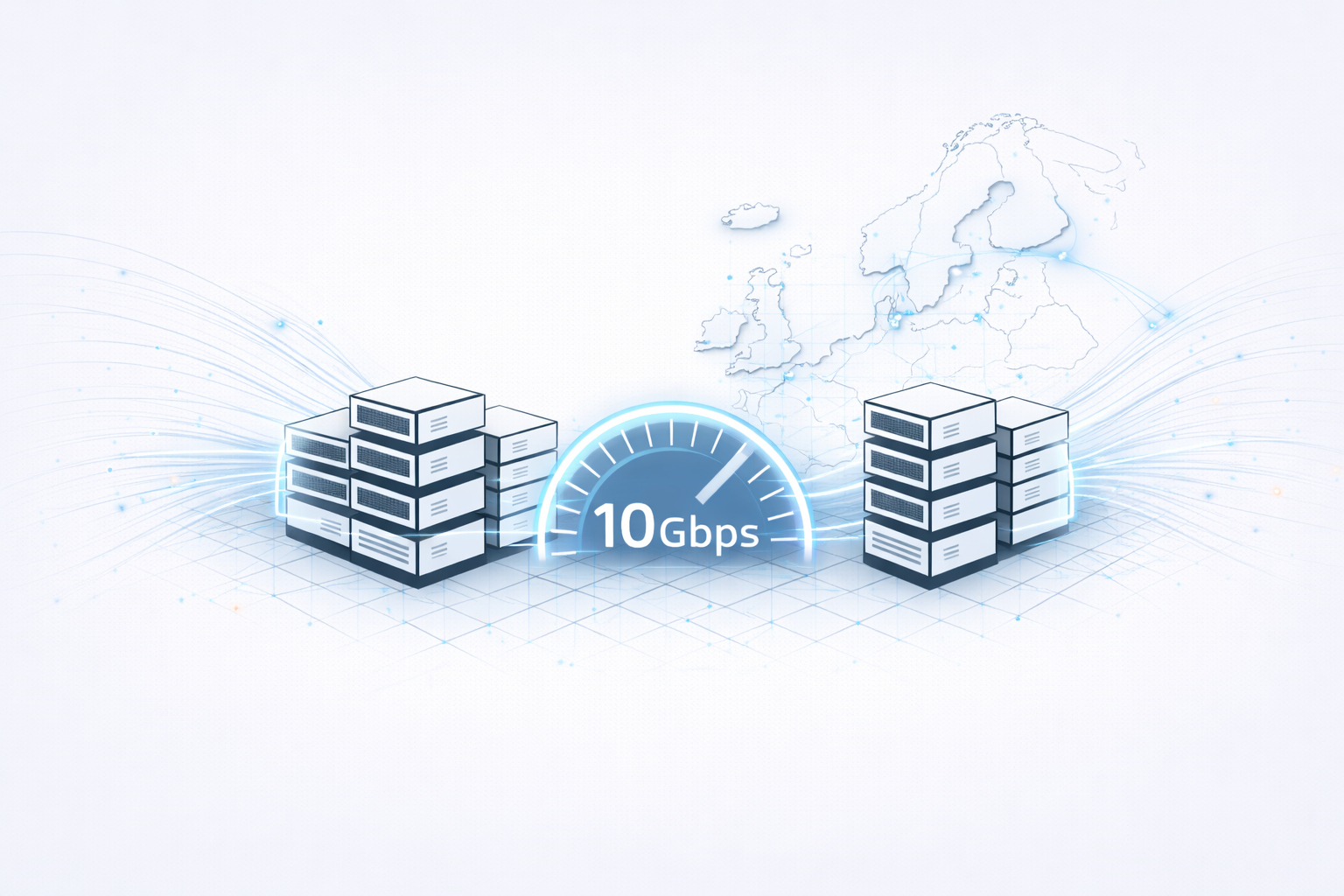




Ultimate Checklist Before Buying a 10Gbps Dedicated Server in Europe
Choosing a 10Gbps dedicated server is not a routine hosting decision. It is a commitment to high-throughput infrastructure where performance, network design, and resilience directly affect business outcomes.
Most buyers focus on bandwidth numbers and pricing. That is a mistake. At 10Gbps scale, the difference between a stable environment and a problematic one is not hardware, it is architecture, routing, and mitigation strategy.
Before comparing speed, pricing, or provider promises, buyers should first understand what separates basic hosting from true dedicated servers in Europe. The right choice depends on network capacity, regional routing, uptime expectations, and whether the infrastructure can support sustained high-volume workloads.
European hosting markets have matured rapidly. High-capacity networks, strong peering ecosystems, and stricter compliance expectations have created both opportunity and complexity.
This guide breaks down what actually matters before you commit to a high bandwidth environment, what trade-offs you will face, and how to evaluate providers offering high bandwidth dedicated servers beyond marketing claims.
Understanding What a 10Gbps Dedicated Server Really Means
A 10Gbps dedicated server is often misunderstood, and that misunderstanding leads to poor decisions. Most buyers assume that higher bandwidth automatically translates into better performance. That assumption is flawed because bandwidth is only one part of a much larger system that determines how infrastructure behaves under pressure.
A 10Gbps configuration is not just about speed. It represents the ability to handle sustained, high-volume traffic consistently without degradation. This means the network must remain stable under load, routing must be efficient, and the underlying hardware must be capable of keeping up with the data flow. Without these elements working together, a 10Gbps port becomes nothing more than a number on paper.
This leads to a fundamental question that most buyers overlook: What is the difference between 1Gbps and 10Gbps dedicated hosting? The difference is not simply a tenfold increase in speed. It is about concurrency, packet handling, and the ability to process multiple high-demand requests simultaneously without bottlenecks forming elsewhere in the system.
Another critical aspect is understanding whether your use case even justifies such capacity. What are typical use cases for a 10Gbps dedicated server? Streaming platforms, gaming networks, and large-scale SaaS applications benefit from this level of bandwidth because they require continuous data transfer without interruptions. However, many businesses overestimate their needs and end up paying for capacity they never fully utilize.
This brings us to a more practical concern: How do I choose a dedicated server with high network capacity? The answer starts with understanding your workload. Without analyzing traffic patterns, concurrency levels, and data transfer requirements, choosing a high bandwidth server becomes guesswork rather than strategy.
Deploy Server in Minutes
Dedicated Servers
Bandwidth vs Throughput
Bandwidth is often presented as the defining metric of performance, but it rarely tells the full story. Throughput, which reflects the actual amount of data transferred successfully over time, is what determines real-world performance.
A provider may advertise a 10Gbps port, but the network’s ability to sustain that throughput depends on multiple factors. One of the most important distinctions is between port speed and actual delivery. While the port may support 10Gbps, network congestion and upstream limitations can significantly reduce effective bandwidth during peak periods. This creates a gap between what is promised and what is delivered.
Another factor is whether the uplink is shared or dedicated. Many providers oversubscribe their networks, meaning multiple users share the same infrastructure. Even if your server has a 10Gbps port, shared uplinks can lead to performance degradation when demand spikes. This is especially problematic for applications that require consistent throughput rather than occasional bursts.
The concept of unmetered bandwidth also requires closer scrutiny. Unmetered bandwidth dedicated server options are often marketed as unlimited, but in practice, they may include fair usage policies that restrict sustained high-volume traffic. Understanding these limitations is essential to avoid unexpected throttling.
This leads to another important question: Dedicated server solutions for high-volume data transfer are they truly built for sustained performance or just advertised for it? The answer depends on whether the infrastructure is designed for continuous load or only capable of handling short bursts. Providers that invest in robust backbone networks and high-capacity routing are better equipped to deliver consistent throughput.
Buyers who want to understand the real difference between advertised port speed and usable performance should review a detailed 10gbps dedicated server performance guide. It helps clarify how throughput, uplink quality, traffic patterns, and provider network design affect actual server performance.
Network Location and Latency Considerations
Choosing the right server location is not as simple as selecting a region close to your users. While proximity can reduce latency, network quality plays a far more significant role in determining overall performance.
European hosting environments are known for strong connectivity, but there are notable differences between locations. For example, a Netherlands vs Romania dedicated servers comparison highlights how routing, latency, and pricing differ across major European hubs. Cities like Frankfurt and Amsterdam act as major interconnection hubs, offering balanced latency across multiple regions. These locations benefit from dense peering networks, which allow data to travel more efficiently between providers.
However, location alone does not guarantee performance. Peering and transit quality determine how data moves across networks. Poor peering agreements can create bottlenecks, even in high bandwidth environments. This is why evaluating network architecture is more important than simply choosing a geographic region.
A relevant question arises here: Best dedicated server hosts offering 10 gigabit connectivity how do you actually compare them? The answer lies in analyzing network routes, interconnection points, and the quality of upstream providers rather than relying on location labels alone.
Another consideration is scalability. Which dedicated server providers offer scalable 10Gbps bandwidth? Scalability depends on the provider’s backbone capacity and their ability to handle increasing traffic without compromising performance. A provider with limited infrastructure may struggle to maintain stability as demand grows.

Non-Negotiable at 10Gbps Scale
At high bandwidth levels, infrastructure becomes more visible and more vulnerable. A 10Gbps server is not just capable of handling large volumes of legitimate traffic, it also attracts malicious traffic in the form of distributed denial-of-service attacks.
This makes DDoS protection a fundamental requirement rather than an optional feature. The effectiveness of protection depends on where mitigation occurs. If filtering happens at the server level, it is already too late to prevent disruption. Effective mitigation must take place upstream, before traffic reaches the server.
Multi-layer protection is another critical factor. Modern attacks often target multiple layers simultaneously, combining network-level and application-level vectors. A single-layer defense is insufficient in such scenarios, as it cannot address the full spectrum of threats.
Transparency in mitigation capacity is equally important. Providers should clearly communicate their ability to handle large-scale attacks. Vague claims about protection capabilities are often a sign that the infrastructure may not be equipped to deal with real-world threats.
At this scale, comparing ddos protection providers dedicated servers europe is essential because not all mitigation systems are equal. The strongest providers filter attacks upstream, maintain clean traffic flow, and disclose how their protection behaves during real network stress.
This leads to a practical question: Where to find 10Gbps dedicated servers with DDoS protection that actually works? If you are evaluating options, reviewing DDoS protection dedicated server solutions in real-world scenarios can help you understand how mitigation actually performs under sustained attacks.
The answer lies in choosing providers that integrate mitigation into their core infrastructure rather than offering it as an add-on. For example, environments like NexonHost are designed with built-in protection layers, ensuring that performance remains stable even during high traffic or attack scenarios.
Hardware Configuration Beyond CPU and RAM
Focusing only on CPU and RAM when selecting a server is a common mistake. At 10Gbps, the entire system must be balanced to prevent bottlenecks from forming in unexpected areas.
Storage performance plays a crucial role in high-throughput environments. NVMe drives are often necessary because they provide significantly faster read and write speeds compared to traditional SSDs. Without adequate storage performance, data cannot be processed quickly enough to match network capacity.
CPU configuration is another key factor. High concurrency workloads benefit from multiple cores rather than high clock speeds alone. This allows the system to handle multiple processes simultaneously without delays.
Memory also contributes to overall performance. Sufficient RAM ensures that applications can cache data effectively and manage parallel operations without relying excessively on disk access.
A relevant question here is: Dedicated server configurations supporting 10Gbps network speeds are they actually optimized for real workloads? The answer depends on how well the hardware components are aligned with the intended use case.
A strong hardware configuration only matters when it is supported by reliable dedicated hosting infrastructure. Storage speed, CPU allocation, RAM capacity, and network stability must work together, especially when workloads depend on sustained data transfer and high concurrency.
Similarly, when evaluating gaming infrastructure, one must consider more than just bandwidth. Compare features of high bandwidth dedicated servers for gaming what actually matters? Low latency, stable packet delivery, and consistent CPU performance are far more important than raw bandwidth alone.
Where Most Buyers Get It Wrong
Pricing in the high bandwidth hosting market varies widely, and this often leads to confusion. Lower prices may appear attractive, but they frequently come with trade-offs that are not immediately visible.
One of the most common issues with low-cost plans is the presence of hidden limitations. Bandwidth throttling, restricted support, and additional fees can increase the total cost over time. These factors are often overlooked during the initial decision-making process.
Another important consideration is performance stability. Providers that offer extremely low prices may rely on oversubscribed networks, which can lead to inconsistent performance during peak periods. This inconsistency can have a direct impact on user experience and operational efficiency.
This raises an important question: Compare pricing for high bandwidth dedicated server providers what are you actually paying for? Looking at a dedicated server performance comparison between OVH and NexonHost can reveal how pricing aligns with real infrastructure quality and network consistency. The answer lies in evaluating the underlying infrastructure rather than focusing solely on the advertised price.
A related concern is long-term sustainability. Affordable 10Gbps dedicated server options with unmetered bandwidth are they viable over time? In many cases, the answer is no, as such plans often rely on limitations that affect performance as usage increases.

What You Should Expect
Deploying a 10Gbps server requires careful planning and ongoing management. It is not a simple plug-and-play solution, and organizations must be prepared to handle the complexity that comes with high-performance infrastructure.
One of the first steps is analyzing traffic patterns before deployment. Understanding how data flows through your system allows for better configuration and optimization. Without this analysis, performance tuning becomes reactive rather than proactive.
Continuous monitoring is also essential. High bandwidth environments require constant oversight to ensure that performance remains stable and potential issues are identified early.
Another key aspect is testing DDoS mitigation systems under real conditions. This ensures that protection mechanisms function effectively when needed.
This leads to a practical question: How to migrate to a 10Gbps dedicated server smoothly? The process involves careful planning, including DNS management, traffic routing, and failover strategies to minimize disruption.
Another consideration is deployment speed. Providers offering instant setup 10Gbps dedicated servers are they always the best choice? While fast deployment can be beneficial, it may come at the cost of customization and optimization.
Is a 10Gbps Server Right for You?
If your workload does not yet require full 10Gbps capacity, reviewing broader dedicated solutions can help you choose a better-fit setup. The smarter decision is matching infrastructure to actual traffic, growth projections, security needs, and budget instead of buying excess capacity too early.
High-traffic platforms such as streaming services and large-scale applications benefit from high bandwidth because they rely on consistent data transfer. Similarly, content delivery networks and large file distribution systems require stable throughput to function effectively.
However, startups and smaller applications may not need such capacity. This raises an important question: Best deals on high bandwidth dedicated servers for startups should you even consider them? In many cases, the answer depends on projected growth rather than current demand.
Another relevant question is: Benefits of 10Gbps dedicated servers for large data transfers do they apply to your use case? If your operations involve significant data movement, the benefits can be substantial. Otherwise, the investment may not provide meaningful returns.
Common Mistakes Buyers Make
Even experienced buyers make mistakes when selecting high bandwidth servers, often due to incomplete information or unrealistic expectations.
One common error is overvaluing bandwidth numbers while ignoring network quality. High port speeds do not guarantee consistent performance, especially in oversubscribed environments.
Another mistake is underestimating the importance of DDoS protection. Assuming that attacks will not occur can lead to costly downtime and service disruptions. Following a structured DDoS mitigation checklist for dedicated servers helps prevent gaps that are often overlooked during initial setup.
Another mistake is underestimating the importance of DDoS protection until downtime exposes weak planning. Following a ddos protection dedicated server checklist 2026 helps verify mitigation capacity, filtering layers, response process, and attack-readiness before committing to a provider.
Choosing providers based solely on price is another frequent issue. While cost is an important factor, it should not outweigh considerations such as infrastructure quality and reliability.
This leads to a critical question: Reviews of high bandwidth dedicated servers for enterprise use are they reliable indicators of performance? Many reviews focus on surface-level features rather than real-world performance, making it important to validate claims independently.
Choosing the Right Provider in Europe
When evaluating providers, the goal is not simply to find the cheapest 10Gbps plan, but to identify dedicated servers in Europe that can deliver consistent routing, scalable bandwidth, transparent protection, and responsive support as traffic demands increase.
Selecting a provider is not about comparing feature lists but about understanding how infrastructure is designed and managed. Providers differ significantly in their approach to network architecture, resource allocation, and mitigation strategies.
A relevant question here is: Top-rated dedicated server companies offering 10gbps plans what differentiates them? The answer lies in their ability to deliver consistent performance, maintain transparency, and provide scalable solutions.
Another important consideration is consistency across different use cases. Reviews of top 10Gbps dedicated server companies do they reflect real-world performance? Evaluating multiple scenarios helps determine whether a provider can handle varying workloads effectively.
For businesses with specific requirements, customization becomes essential. Get a quote for a custom high bandwidth dedicated server configuration to ensure that the infrastructure aligns with your operational needs.
Making the Right Infrastructure Choice
A 10Gbps dedicated server is not just about achieving higher speeds. It is about maintaining stability when traffic increases, ensuring resilience against disruptions, and supporting long-term growth without constant reconfiguration.
As businesses scale, infrastructure decisions become more strategic. Choosing a provider that prioritizes performance consistency, integrated protection, and transparent architecture can significantly reduce operational risks. Platforms like NexonHost focus on building controlled environments designed to sustain high loads, making them a practical choice for organizations that require reliability at scale.
The real value of a 10Gbps server lies not in its specifications but in how well it supports your workload under real conditions. Making informed decisions at this stage ensures that performance remains consistent, costs are controlled, and future scalability is not compromised.
Deploy Server in Minutes
Dedicated Servers
FAQs
Do I really need a 10Gbps dedicated server?
You need a 10Gbps dedicated server only if your application consistently handles large-scale traffic or high concurrency. In many cases, a 5gbps dedicated server or even lower bandwidth setup is sufficient when properly optimized. Choosing based on actual workload prevents unnecessary costs and avoids overprovisioning infrastructure.
Are unmetered dedicated servers always better?
Unmetered servers are beneficial for high traffic environments, but they are not always better. Network quality, routing efficiency, and provider infrastructure matter more. Many unmetered plans include fair usage policies that can limit sustained performance, making it important to evaluate actual delivery rather than advertised capacity.
Does DDoS protection affect performance?
Effective DDoS protection should not impact performance when properly implemented. High-quality systems filter malicious traffic before it reaches the server, preserving speed and stability. Whether you are using a 10Gbps or 5gbps dedicated server, poorly configured mitigation can introduce latency, making provider quality a critical factor.
Is Europe a good location for high bandwidth hosting?
Europe is a strong region for high bandwidth hosting due to its dense interconnection hubs and advanced network infrastructure. However, performance depends on specific locations, peering quality, and routing efficiency rather than the region itself. Proper evaluation is necessary to ensure optimal results.
What is the biggest mistake when choosing a provider?
The biggest mistake is focusing only on pricing or bandwidth specifications without evaluating infrastructure quality. Buyers often ignore network architecture, DDoS protection, and real-world performance. Even when choosing between a 10Gbps and 5gbps dedicated server, decisions should be based on workload fit, not marketing claims or headline speeds.