
























How Remote Layer 7 DDoS Protection Works: Protecting Apache, Nginx, WordPress & Linux Servers from Modern HTTP Flood Attacks
NexonHost’s low-latency DDoS proxy operates through optimized European scrubbing centers. Your website remains fast, responsive, and fully protected, ensuring a smooth user experience even under high traffic.
Remote Website DDos Protection Services – NexonHost.com
High-availability web applications require a multi-layered defense strategy. Relying solely on network-level firewalls is no longer sufficient against application-layer threats. While volumetric DDoS attacks try to saturate an internet port with raw traffic, semantic or “low and slow” exploits like Slowloris, automated web scrapers, and query injections target the internal connection handling and application logic of your web stack.
Whether your infrastructure is hosted on a high-performance germany dedicated server, a secure netherlands dedicated server hosting platform, deploying an advanced, fully-featured Layer 7 ddos protection proxy is the standard architectural blueprint to shield your origin applications.
Origin Shielding: Only traffic that passes all security checks is sent over a clean, persistent upstream tunnel to your actual backend server (Origin). Your origin server’s real IP address remains hidden from the public internet, protecting it from direct IP-based attacks.
Protect your website, applications, and APIs with enterprise-grade DDoS mitigation and dedicated Slowloris attack protection. NexonHost’s Layer 7 DDoS protection proxy identifies and blocks attacks in real-time while maintaining low latency and SSL security, ensuring your site stays online, fast, and trusted.
Our Remote Layer 7 DDoS Protection functions as an intelligent, off-site shield that filters out this malicious traffic before it ever reaches your actual web server hosting the application.
Our clients are important to us, so please consider to reach our specialists in order to discuss about your options: Contact NexonHost | Sales, Support & Hosting Inquiries
NexonHost Enterprise Layer 7 Proxy Architecture
NexonHost integrates high-performance hosting infrastructure with a dedicated application-layer (Layer 7) mitigation engine. Designed to complement their high-capacity unmetered dedicated servers, VPS deployments, and European colocation hubs (spanning Germany, the Netherlands, and Romania), the NexonHost Layer 7 proxy filters malicious, automated traffic before it consumes origin compute resources.
All DDoS protection services come with an SSL-enabled DDoS proxy for encrypted HTTPS traffic. This keeps customer data safe and ensures full
compliance with EU cybersecurity standards.Experience secure, high-speed traffic filtering with minimal impact on performance.
Effective website protection should do more than place a basic firewall in front of your site. It should help safeguard your origin server, filter malicious requests, reduce downtime risk, and keep legitimate users connected with minimal latency.
By intercepting HTTP/HTTPS connection pipelines at specialized European scrubbing centers, NexonHost decouples protocol handshakes from your main server application stack.
Block Attacks Instantly
DDoS Protection
1. Reverse Proxy & Traffic Ingestion Flow
The proxy operates via an infrastructure-backed Reverse Proxy Topology. By mapping your domain’s public DNS A/AAAA records directly to NexonHost’s secure edge scrubbing network, your physical origin backend (Apache, Nginx, IIS, or a standalone WordPress droplet) is completely hidden behind a protective virtual curtain.
Edge SSL/TLS Termination: The proxy edge ingests incoming data and terminates the cryptographic TLS layer. This handles the massive CPU strain of modern SSL handshakes at the network edge, isolating the backend server from handshake floods.
Clean Upstream Aggregation: Once traffic passes checking rules, it is funneled through optimized, pre-allocated Persistent Keepalive Connection Pools straight to your application. This prevents the “TCP handshake churning” that usually causes backend OS thread exhaustion under heavy load.
2. Multi-Layer Mitigation Matrix
To maintain near-zero latency, the NexonHost proxy pipeline uses adaptive, behavioral security profiles to separate malicious requests from real clients:
Asynchronous Engine Verification (Anti-Bot Challenges)
If traffic spikes hit dynamic endpoints (such as wp-login.php, xmlrpc.php, or general API nodes), the proxy drops direct backend mapping and issues a lightweight, cryptographic JavaScript Challenge.
- Real browsers easily resolve this background math computation and transparently save an authorized session token.
- Malicious HTTP GET/POST flood utilities, automated scrape scripts (Python, Go, Node.js), and headless bots fail to parse the JavaScript payload. They are permanently cut off at the edge before sending a single query to your database.
Payload Sanitization Web Application Firewall (WAF)
The edge uses high-speed pattern recognition to scan the anatomy of incoming packets:
- It analyzes query components for common injection threats (such as SQL Injection rules and Cross-Site Scripting snippets).
- It blocks broken or malformed requests (like those missing Host or User-Agent structural strings) commonly used to exploit application vulnerabilities.
- It enforces tight traffic throttling profiles across granular target areas to insulate database layers from query-heavy exhaustion.
3. Edge Dropping vs. Kernel Escalation
Processing large-scale application exploits can consume significant computing resources. The NexonHost engine optimizes this processing through a split-tier dropping protocol:
User-Space Discarding (HTTP 444): Requests violating immediate access control, geography restrictions, or layer 7 parameters trigger an abrupt Nginx 444 Close Connection sequence. The edge socket cuts the connection without returning response bodies or header structures, preserving outbound bandwidth.
Kernel-Level Dropping (ipset / iptables): Persistent attackers are automatically escalated down to the Linux network kernel. The system injects the offending IP into a hash-based set (ipset). Subsequent packets are dropped at the transport layer before any proxy worker engine expends CPU cycles parsing them.
Understanding the Slowloris Attack (Anatomy of the Threat and its signs)
Unlike traditional volumetric DDoS attacks that attempt to saturate network bandwidth with millions of packets, Slowloris operates on a “low and slow” principle. It is a highly efficient Denial of Service (DoS) attack that targets the application layer (Layer 7).
What Are the Signs of a Slowloris DDoS Attack?
Much as its name implies, a Slowloris DDoS attack is slow and methodical. The attack involves sending partial HTTP requests to the targeted web server, with none ever being completed. As a result, the targeted server opens more connections, assuming the requests will be completed.
Eventually, the server’s maximum allotted connection sockets are consumed one-by-one until fully exhausted, thus blocking any legitimate connection attempts.
High-traffic websites may take longer to exhaust, but the result is the same when Slowloris succeeds: available connection slots are consumed by incomplete requests, and legitimate users may receive timeouts, failed connections, or service unavailable errors.
The Lifecycle of a Slowloris Exploit:
- Socket Initiation: The attacking script opens hundreds of standard HTTP connection sockets toward your public endpoint.
- The Partial Header Trick: Instead of transmitting a standard, complete HTTP request header immediately, the script drips data at a crawl sending individual lines or random characters every 10/15 seconds.
- Thread Holding: Traditional thread-based web application servers (like classic Apache deployments) are designed to wait for the completion of a client’s header before processing or timing out. The server holds these sockets open indefinitely.
- Connection Pool Exhaustion: Within seconds, the target server reaches its configured max socket limitations (MaxClients or concurrent connection pools).
- Denial of Service (DoS): The platform completely stops accepting incoming traffic. Legitimate user requests are dropped, despite the fact that your server’s overall CPU, RAM, and overall network bandwidth allocation appear entirely clear.
How to Protect Your Website from Slowloris Attacks Using a V7 Proxy
Hardening the Proxy Layer
When setting up a high-performance Layer 7 proxy (such as NGINX or OpenResty) on your Nexonhost server, your primary goal is to isolate your core application (e.g., WordPress, Magento, or custom PHP/Node.js apps) from managing raw incoming TCP sockets directly.
Enforce Strict Packet Expiration Timeouts
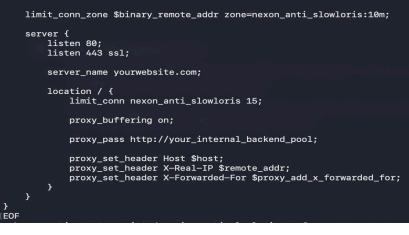
Slowloris relies on keeping sockets open indefinitely by dripping data lines at a crawl. By enforcing aggressive timeout thresholds inside your HTTP configuration blocks, you instruct the proxy to forcibly sever connections that drift or stall.
Add these directives to your edge proxy configuration file:
The Architectural Solution: Connection Buffering via Layer 7 Proxy
A standard Layer 4 network firewall only inspects incoming packets at the protocol level (IP addresses and ports). It cannot detect a Slowloris attack because every single socket looks like a valid TCP handshake.
By inserting a high-performance, reverse proxy framework at the edge of your infrastructure, you decouple connection management from application rendering using Connection Buffering.
- The Proxy Barrier: Threat actors and automated tools interact directly with your edge proxy rather than your production application nodes.
- Asynchronous Validation: The Layer 7 proxy handles the slow client interaction completely. It explicitly refuses to proxy, spawn threads, or allocate backend resources until the complete HTTP request header has been safely compiled.
- Backend Preservation: Your real high performance dedicated server only ever receives clean, fully formed, rapid requests, isolating its internal stack from connection-exhaustion tactics.
Comprehensive Configuration Modules
To build an enterprise-grade Web Application Firewall (WAF) using an advanced proxy layout, you must enforce rules across multiple logical sub-tabs:
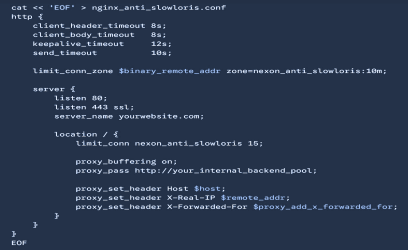
Module A: Global Timeouts & Connection Limits (Ports & Core)
Configure the edge layer to drop connection promptly if a client takes too long to send data, and restrict maximum concurrent sockets from a single host.
Module B: Request Filtering (WAF Engine)
Request Filtering blocks malicious or unwanted requests based on headers, URL paths, query parameters, and HTTP methods, returning an immediate 403 Forbidden or a silent 444 connection drop (closing the connection with no response body).
Request filtering blocks malicious or unwanted traffic before it reaches the backend. The proxy can inspect headers, URLs, query strings, user agents, and HTTP methods to identify suspicious requests. This helps stop common probes such as SQL injection attempts, XSS payloads, path traversal requests, empty user-agent traffic, and attacks targeting sensitive files or WordPress admin endpoints.
Module C: HTTP Method Restraints
Lock down your web cluster by restricting accepted HTTP request methods. Many platforms only require standard content fetching and simple forms. Allowing unneeded methods introduces unnecessary security surface area.
Once these proxy controls are in place, the backend impact becomes clear. Apache, Nginx, and WordPress no longer have to waste server resources on incomplete, malformed, automated, or abusive requests before legitimate traffic reaches the application.
About Core Architecture & Reverse Proxy Options
WorldShield runs on top of a highly optimized Nginx reverse proxy core, acting as an intelligent intermediary that sits in front of backend origin servers. It distributes incoming web traffic efficiently and shields backends from being directly exposed to the public internet. It offers a lightweight alternative to traditional web application firewalls and complex infrastructure providers. Configurations are organized seamlessly via virtual hosts (vhosts) within the panel. Using the master/slave replication feature, a central master server can securely synchronize reverse proxy configurations, whitelists, blacklists, and caching structures across multiple unmetered dedicated servers or VPS nodes scattered throughout Europe (such as endpoints in Germany, the Netherlands, or Romania).
Layer 7 DDoS Mitigation & Protection Tools
WorldShield achieves high-throughput defense by dividing its protection across two layers:
Kernel-Level Dropping (Layer 3/4): Offending traffic is blocked instantly before it ever touches Nginx using Linux kernel-level
iptables and ipset firewall structures. This drops abusive packets silently at the network layer, freeing up severe CPU strain during volumetric floods.
Application-Level Dropping (Layer 7): Traffic passing through is filtered dynamically. Unwanted request payloads receive an immediate 444 status code response, a unique Nginx command that drops the TCP connection silently without returning a response body.
The platform utilizes TestCookie, a JavaScript-based browser validation engine to challenge untrusted Layer 7 traffic. When enabled, automated scrapers, bots, and Layer 7 flooding tools that cannot execute JavaScript fail the cryptographic cookie challenge and are permanently blocked, while real human visitors experience a transparent redirection.
Request Filtering presets
The system includes an integrated lightweight Web Application Firewall (WAF) capable of pattern-matching incoming parameters against built-in protection rules for SQL Injection (e.g., union.*select), Cross-Site Scripting (XSS), Directory Path Traversal, and Code Injection attacks.
Dual-Layer Drop Mechanics: Nginx Edge vs. Kernel Escalation
To mitigate aggressive floods without causing local socket starvation or processing overhead, WorldShield utilizes a cascading drop strategy across the user space and kernel space:
- Silent User-Space Drops (Nginx HTTP 444): For requests that violate immediate access control or rate-limiting rules, Nginx invokes the non-standard 444 Connection Closed Without Response directive. This forces an immediate TCP RST (Reset) or FIN at the socket level without consuming outbound network bandwidth or transmitting HTTP headers, freeing worker memory instantaneously.
- Kernel-Level Offloading (iptables + ipset): If a malicious IP address persistently generates blocked requests, the platform’s security daemon escalates the mitigation. The offending IP is injected into a highly efficient hash-based network structure (ipset, such as myblacklist). Subsequent packets from that host are dropped silently at the Linux kernel layer via iptables before Nginx can spend any CPU cycles parsing the TCP handshake or HTTP state machine.
TCP Metric Monitoring & Slow-Rate Attack Defenses
Application-layer attacks like Slowloris or Slow HTTP Read/Write exploit the HTTP protocol by opening persistent connections and transmitting data at an intentionally exhausting, fractional rate to occupy the server’s finite thread pool. WorldShield proactively thwarts connection-drain tactics:
- State Auditing via ss: The system programmatically monitors socket states using low-level network tools (e.g., ss -tn state established) on critical web ports to detect and flag abnormally long-lived, unproductive TCP connections.
- Aggressive Timeout Policies: The reverse proxy enforces tight operational limits on header and body transmission intervals via optimized directives (such as client_header_timeout and client_body_timeout). If a client stalls during data transmission, the edge proxy terminates the socket connection immediately.
Upstream Optimization & Passive Cache Shielding
Beyond active traffic blocking, WorldShield minimizes origin stress by serving as an intelligent buffer between the public internet and your backend environment:
- Keepalive Connection Pooling: By maintaining persistent, pre-allocated upstream TCP connections between the proxy nodes and the backend servers, the system minimizes the overhead of repetitive TCP handshakes and TLS negotiations during traffic spikes.
- Micro-Caching & Stale Content Failover: For highly dynamic pages under active exploitation, WorldShield can be configured to cache responses for micro-intervals (e.g., 1–2 seconds), absorbing heavy concurrent requests at the proxy level. Furthermore, if the backend server becomes temporarily overloaded or fails to respond, the proxy can seamlessly deliver stale cached content to legitimate users, maintaining 100% perceived uptime.
overloaded or fails to respond, the proxy can seamlessly deliver stale cached content to legitimate users, maintaining 100% perceived uptime.
Block Attacks Instantly
DDoS Protection
Benefits for Apache, Nginx, and WordPress Backends
Implementing remote mitigation radically transforms how your origin server handles high-stress environments:
- Eliminates Database Exhaustion: WordPress relies heavily on MySQL/MariaDB queries. By filtering out floods at the proxy edge, your backend server is spared from concurrent database connection spikes that typically cause the infamous “Error Establishing a Database Connection” crash.
- Optimized Upstream Pooling (Keepalive): Instead of your origin server constantly opening and closing TCP/TLS handshakes for every single visitor request, the remote proxy maintains a pool of pre-established, persistent connections (Keepalive) back to your server. This drastically lowers CPU overhead on your origin Linux server.
- Micro-Caching and Failover Shielding: If a sudden traffic spike hits a dynamic page, the remote proxy can cache the page response for micro-intervals (e.g., 1–2 seconds), serving thousands of users out of cache memory without hitting your application logic. If your backend server goes down for maintenance, the proxy can seamlessly serve “stale” cached content, keeping the site visibly online.
Who needs DDoS protection?
Website DDoS protection is useful for ecommerce stores, SaaS platforms, business websites, gaming communities, forums, agencies, publishers, and high-traffic websites. Any website that depends on uptime, customer access, leads, or online revenue should consider stronger protection.
Layer 7 DDoS protection is especially useful against Slowloris attacks because it stops incomplete HTTP requests before they can exhaust backend server connections. By placing a protected proxy in front of Apache, Nginx, WordPress, or Linux-based applications, NexonHost helps shield the origin server, filter malicious traffic, manage SSL traffic, and keep legitimate users connected during application-layer attacks.