Self-hosted web analytics means running the tracking script, database and dashboard on a server you rent, instead of sending visitor data to a vendor. Matomo, Plausible and Umami each publish a free edition for it. The software costs nothing; the server, updates and backups are yours. This guide compares the three from their own docs and maps Matomo's sizing to plans.
Why teams self-host: control, not a ban
The usual reason is control: raw visit data sits in a database you run in the EU, no analytics vendor receives it, and you set the retention.
It is not that US tools are banned. On 10 July 2023 the European Commission adopted its adequacy decision for the EU-US Data Privacy Framework (Implementing Decision (EU) 2023/1795): personal data can flow to US companies participating in the Framework "without having to put in place additional data protection safeguards". On 3 September 2025 the EU General Court dismissed Philippe Latombe's action to annul it (Case T-553/23), confirming that when the decision was adopted the United States "ensured an adequate level of protection". He has appealed (Case C-703/25 P, lodged 31 October 2025); we found no ruling on it by 23 November 2026. The Commission's adequacy page still lists the US. It is not frozen: the Commission must monitor US law and may suspend, amend or repeal the decision.
How transfers and residency fit together is in our EU data residency guide. This describes published rules; it is not legal advice.
The consent question: what the CNIL allows
The stronger argument is consent scope. France's regulator, the CNIL, says audience-measurement cookies can be exempt from consent under Article 82 of the French data protection act if they are used only to measure the site's audience, "pour le compte exclusif de l'éditeur" (for the publisher alone), and produce anonymous statistics only. They must not be cross-referenced with other processing, pass non-anonymous data to third parties, or follow a person across sites or apps.
It also recommends telling users, a cookie lifetime such as 13 months that is not extended on later visits, and keeping data at most 25 months. The page is dated 4 July 2025 and warns publishers about transfers outside the EU by their provider. Other EU authorities publish their own positions; check yours.
Matomo publishes a self-assessment against these criteria and a CNIL mode (Administration > Privacy > Compliance) for On-Premise and Cloud. It masks 3 bytes of each visitor's IP address (at least 2 are required), deletes raw data after 744 days (never more than 759), caps tracker cookies at 13 months (already the default), and switches off User ID, the Visits Log, visitor profiles, heatmaps and session recordings. You still disable third-party cookies and publish a visible opt-out yourself. Enabling it permanently deletes existing A/B-test data.
The exemption comes from configuration, not location: an instance with User ID switched on does not qualify, wherever it runs.
Matomo vs Plausible vs Umami: stack, licence, minimums
From each project's own docs and repository, read 23 November 2026:
| Tool (version read) | Stack | Licence | Stated minimum |
|---|---|---|---|
| Matomo On-Premise 5.14.3 | PHP 8, MySQL 5.5+ or MariaDB | GPL v3 or later | 2 CPU, 2 GB RAM, 50 GB SSD (≤ 100,000 pageviews a month) |
| Plausible CE v3.2.1 | Elixir, PostgreSQL, ClickHouse (Docker Compose) | AGPL v3 or later | SSE 4.2 or NEON CPU; 2 GB RAM recommended |
| Umami v3.5.0 | Node.js 20.19+, PostgreSQL 12.14+ | MIT | none stated |
Matomo 6 is at release candidate; its requirements page lists PHP 8.1 and MySQL 8.0 or MariaDB 10.6 for it, so plan a new install around those. Umami v3 dropped MySQL; a v2 MySQL install must migrate to PostgreSQL before upgrading.
Plausible's CPU line matters on any VPS: run grep -c sse4_2 /proc/cpuinfo first; above zero means the flag is exposed.
What the free self-hosted editions leave out
- Matomo On-Premise. The core is open source. Premium features on the Matomo Marketplace, such as Media Analytics, Audit Log and A/B testing, are paid and not open-source licensed.
- Plausible CE. No marketing funnels, user journeys, ecommerce revenue goals, SSO or sites API. Basic bot filtering (User-Agent and referrer spam) instead of Cloud's data-centre IP exclusion, a long-term release twice a year, community support only.
- Umami. Its docs say self-hosted and Cloud "share the same analytics features"; email reports are Cloud-only. Session replays (v3.1 or later) and heatmaps (v3.2 or later) are included when you self-host.
Want heatmaps or session replays and the CNIL exemption? Matomo's CNIL mode turns both off, and its self-assessment treats them as outside the exemption.
Sizing: Matomo's traffic bands, mapped to plans
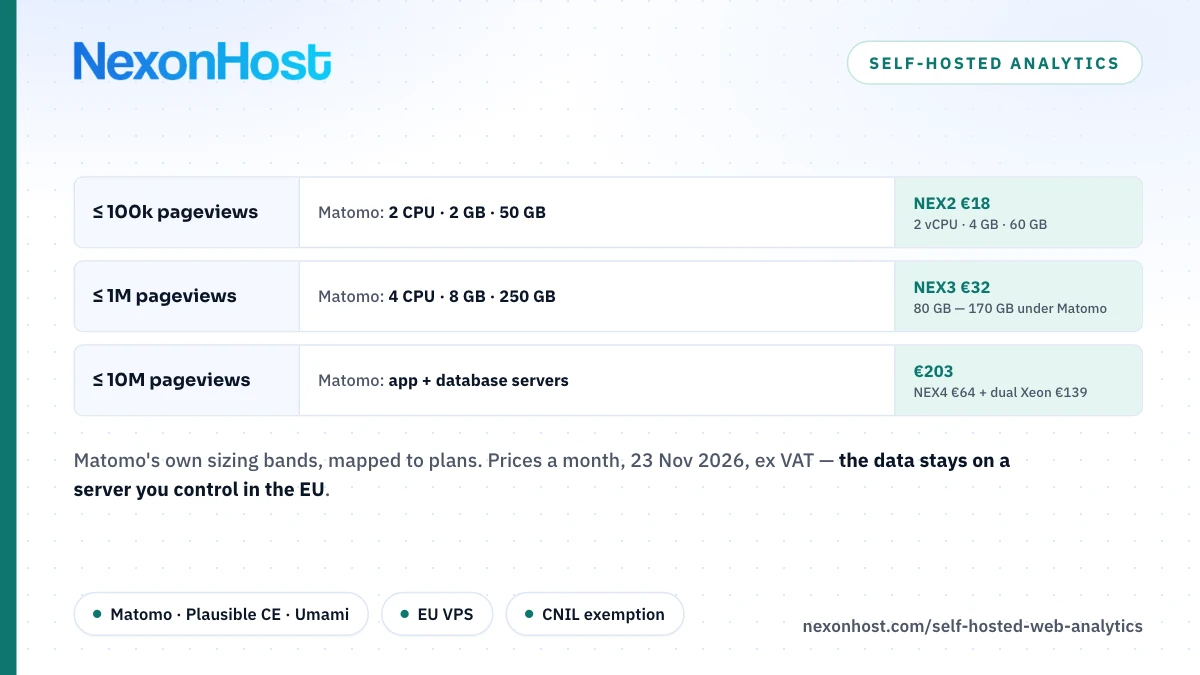
Matomo's docs size by traffic and count requests, so events and downloads count alongside pageviews. Prices as of 23 November 2026, EUR ex VAT, a month:
| Tracked a month | Matomo's minimum | Plan | € a month |
|---|---|---|---|
| ≤ 100,000 | 2 CPU, 2 GB, 50 GB SSD | NEX2: 2 vCPU, 4 GB, 60 GB SSD | €18 |
| ≤ 1 million | 4 CPU, 8 GB, 250 GB SSD | NEX3: 4 vCPU, 8 GB, 80 GB SSD (170 GB short) | €32 |
| ≤ 10 million | App: 8 CPU, 16 GB, 100 GB. DB: 8 CPU, 16 GB, 400 GB | NEX4 + 2× Xeon E5-2630 v4 server, 2× 500 GB SSD | €64 + €139 = €203 |
Up to 100,000. NEX1's single vCPU misses Matomo's two. NEX2 meets all three, with 4 − 2 = 2 GB of RAM and 60 − 50 = 10 GB of disk to spare.
Up to 1 million. NEX3 meets the CPU and RAM exactly but is 250 − 80 = 170 GB short on disk: below Matomo's recommendation. Matomo's own growth estimate is about 1 GB of database per 5 million pageviews: 12 million a year ÷ 5 million = 2.4 GB a year. On that estimate NEX3 can work, but that is our reading, not Matomo's; if you start there, watch the disk. To meet the recommendation, the 20-core dual Xeon E5-2630 v4 server with 2× 500 GB SSD is €129 + €10 = €139 a month; to stay on a VPS, the STG3 Storage VPS (4 vCPU, 8 GB, 800 GB SSD) is €159.
Up to 10 million. Matomo recommends separate app and database servers above 1 million. NEX4 matches the app server exactly. The same €139 server, disks mirrored in RAID 1 (a checkout option), gives the database 500 GB, 128 GB of RAM and 40 threads; growth is 120 million a year ÷ 5 million = 24 GB a year. Keep both in one country: dedicated cities include Frankfurt, Amsterdam and Bucharest, in the three VPS countries (Ashburn, also listed, is outside the EU).
Without traffic bands for the other two: Plausible's 2 GB recommendation matches NEX1 (€9) with nothing spare; NEX2 at €18 doubles it. Umami's docs give no hardware figure, so start on NEX1 or NEX2 and measure.
Backups, updates and TLS
Backups. Matomo's FAQ documents a mysqldump --single-transaction export: a 5 GB database takes about 2 minutes to back up and 12 to restore. On a single database server past 1 million actions a month or 10 GB, it recommends Percona XtraBackup instead. Plausible stores data in PostgreSQL and ClickHouse, so back up both; Umami has one PostgreSQL database.
Keep the copy off the VPS. Two years at 1 million pageviews a month is about 2 × 2.4 = 4.8 GB; 30 daily copies is 30 × 4.8 = 144 GB, inside the 1 TB backup storage add-on at €5 a month, reached over SFTP. Ask which country that space is in: a copy outside the EU undoes the residency you self-hosted for.
Updates. Plausible says security fixes are not backported and recommends pinning an exact version. Umami updates with docker compose pull and a recreate. Above a few hundred visits a day, Matomo says to process reports by hourly cron rather than when someone opens a report.
TLS and the host. Plausible CE issues its own Let's Encrypt certificate when its ports are 80 and 443; Matomo and Umami take theirs from your web server or reverse proxy. Our new server security checklist covers SSH, firewall and patching. To deploy containers from a dashboard, a self-hosted PaaS can run Plausible or Umami.
What self-hosting does not solve
Ad blockers. Matomo's FAQ says some ad blockers stop its tracking code from running, and those visits are not recorded. Plausible's docs say some blocklist maintainers "block all analytics regardless of privacy practices". Expect undercounts.
Compliance. Self-hosting does not by itself make analytics lawful or consent-free. A database in Germany with User ID on is still personal-data processing that needs a legal basis and a retention policy, and Matomo says its CNIL self-assessment is "not designed to evaluate the overall legal compliance" of a setup.
The admin work. Plausible's CE page says that self-hosting makes you responsible for "installation, maintenance, upgrades, server capacity, uptime, backup, security".
Where to start
For most sites under 100,000 pageviews a month, self-hosted web analytics starts on a NEX2 Linux VPS: 2 vCPU, 4 GB of RAM, 60 GB of SSD and 8 TB of traffic for €18 a month (€16.20 a month billed annually), in Germany, the Netherlands or Romania. Pick Matomo for its documented CNIL mode and sizing, Plausible CE if a single-page dashboard is enough and the SSE 4.2 check passes, Umami for the shortest stack: one app and PostgreSQL.
Bigger plans are in the VPS range and on dedicated servers. Every plan includes 100 Gbps Layer 4 DDoS protection, which does not filter HTTP-level floods at your tracking endpoint. The checkout preselects the 1 TB backup add-on at €5 a month; keep it. Start on a one-month term and measure real traffic before committing. Prices as of 23 November 2026, EUR ex VAT; check the product page.
Sources
- CNIL — Cookies : solutions pour les outils de mesure d'audience, consent-exemption conditions and recommendations (13 months, 25 months), dated 4 July 2025, retrieved 23 November 2026
- Matomo — Configure Matomo to comply with the CNIL consent exemption: self-assessment, IP mask 3 bytes (minimum 2), raw data 744 days (maximum 759), 13-month cookies (default), features disabled, manual opt-out, not an overall legal-compliance assessment, retrieved 23 November 2026
- European Commission — Press release IP/23/3721, adequacy decision for the EU-US Data Privacy Framework, 10 July 2023, retrieved 23 November 2026
- Court of Justice of the EU — Press release No 106/25, General Court judgment in Case T-553/23 Latombe v Commission, 3 September 2025; Implementing Decision (EU) 2023/1795, retrieved 23 November 2026
- Official Journal of the EU — C/2025/6610: appeal brought on 31 October 2025 by Philippe Latombe against the judgment in Case T-553/23 (Case C-703/25 P), Publications Office of the EU, retrieved 23 November 2026
- European Commission — Adequacy decisions: the United States (commercial organisations participating in the EU-US Data Privacy Framework), retrieved 23 November 2026
- Matomo — Requirements for Matomo On-Premise: PHP and database versions for Matomo 5 and 6, server sizing by pageviews a month, retrieved 23 November 2026
- Matomo — Configure Matomo for speed: about 1 GB of database per 5 million pageviews, retrieved 23 November 2026
- Matomo — Set up auto-archiving of your reports: hourly cron above a few hundred visits a day, retrieved 23 November 2026
- Matomo — Backup and restore the Matomo data: mysqldump, 5 GB in about 2 minutes to back up and 12 to restore, Percona XtraBackup for 1M+ actions or 10 GB+, retrieved 23 November 2026
- Matomo — What are Premium plugins: not open-source licensed; Media Analytics, Audit Log, A/B Testing, retrieved 23 November 2026
- Matomo — Licences: GNU General Public License v3.0 (or later), retrieved 23 November 2026
- Matomo — GitHub releases: 5.14.3 stable (16 November 2026), 6.0.0-rc2 pre-release, retrieved 23 November 2026
- Matomo — Why Matomo click data differs: some ad blockers prevent the tracking code from running, retrieved 23 November 2026
- Plausible Community Edition — README: SSE 4.2 or NEON CPU, 2 GB RAM recommended, Let's Encrypt on ports 80/443; compose.yml runs Plausible, PostgreSQL and ClickHouse, retrieved 23 November 2026
- Plausible Community Edition wiki — Configuration (PostgreSQL for user data, ClickHouse for analytics data) and Upgrade (fixes not backported, pin a patch version), retrieved 23 November 2026
- Plausible — Self-hosted page: CE vs Cloud features, twice-yearly release, basic bot filtering, community support, AGPLv3 or later, retrieved 23 November 2026
- Plausible — GitHub releases: v3.2.1 (15 May 2026), retrieved 23 November 2026
- Plausible docs — Bypass adblockers with a proxy: some blocklists block all analytics, retrieved 23 November 2026
- Umami docs — Installation: Node.js 20.19 or newer (22 LTS recommended), PostgreSQL 12.14 minimum, retrieved 23 November 2026
- Umami docs — Migrate MySQL to PostgreSQL: MySQL removed in v3, retrieved 23 November 2026
- Umami docs — Cloud overview: Cloud vs self-hosted feature table, retrieved 23 November 2026
- Umami — GitHub repository: README (Docker update steps), MIT licence, v3.5.0 (12 November 2026), retrieved 23 November 2026
- NexonHost store and product pages — NEX VPS plans and regions (Germany, the Netherlands, Romania), 2× Xeon E5-2630 v4 dedicated build, disk and RAID options, STG3 Storage VPS (4 vCPU, 8 GB, 800 GB SSD, €159), dedicated cities, backup storage (SFTP, €5 per TB), included 100 Gbps Layer 4 DDoS protection, retrieved 23 November 2026
- Computed — 4 − 2 = 2 GB; 60 − 50 = 10 GB; 250 − 80 = 170 GB; 1 million × 12 = 12 million ÷ 5 million = 2.4 GB a year; 10 million × 12 = 120 million ÷ 5 million = 24 GB a year; 2 × 2.4 = 4.8 GB; 30 × 4.8 = 144 GB; €129 + €10 = €139; €64 + €139 = €203; 2 × 500 GB in RAID 1 = 500 GB usable