Self-hosted object storage means running your own S3-compatible endpoint, the API your backup tools and applications already speak, on disks you rent by the month instead of per gigabyte. The software choice changed in 2025, when the community edition of the default pick, MinIO, went source-only and then into maintenance mode. Below: four options compared from their own repositories, what one server protects against, and usable capacity on a real build.
The four candidates in 2026
All four speak the S3 API. They differ in licence, minimum machines and operational work.
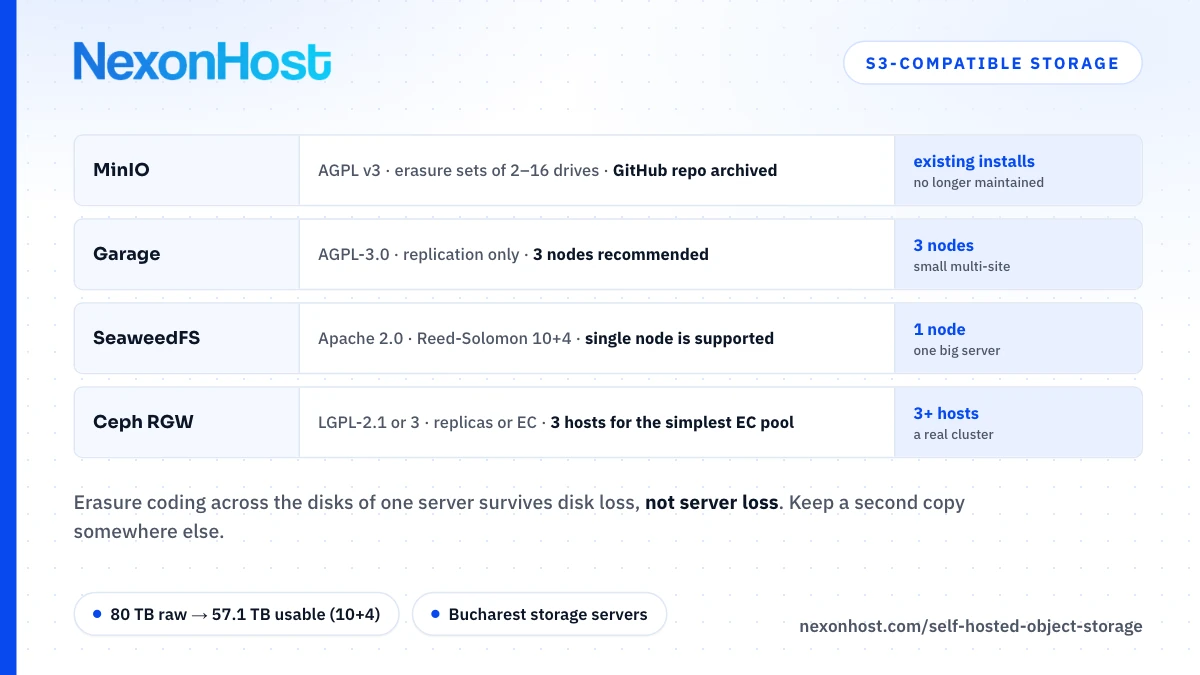
| Software | Licence | Nodes for redundancy | Data protection | Best fit |
|---|---|---|---|---|
| MinIO (community) | GNU AGPL v3.0 | 1 (multi-drive) | Erasure coding, sets of 2–16 drives | Existing installs only |
| Garage | AGPL-3.0 | 3 recommended | Replication only, no erasure coding | Small multi-site clusters |
| SeaweedFS | Apache License 2.0 | 1 for EC across disks | Replication (hot), RS 10+4 (warm) | One big server, many files |
| Ceph RGW | LGPL-2.1 or LGPL-3 | 3 hosts | Replication or erasure-coded pools | Three or more hosts, a team |
Licences are as each project's repository states them on 2 November 2026. This is not legal advice: AGPL carries obligations if you modify the software and offer it over a network, so read the licence first.
MinIO: what changed in 2025
MinIO's own repository has the dates, which matter if you are looking for a MinIO alternative:
- 24 May 2025. The release notes for RELEASE.2025-05-24T17-08-30Z say the "Embedded UI Console is now deprecated" and moved to a separate object-browser project, and that LDAP/OIDC logins were removed and are "now available as part of the AiStor Product".
- 15 October 2025. The README was changed to "source only releases". It now says the community edition "is now distributed as source code only" and that legacy binaries "will not receive updates". The last GitHub release is RELEASE.2025-10-15T17-29-55Z, a security fix.
- 3 December 2025. The README opened with "Maintenance Mode": no new features, and critical security fixes "may be evaluated on a case-by-case basis".
- 12 February 2026. The banner became "THIS REPOSITORY IS NO LONGER MAINTAINED", pointing to AIStor Free ("standalone edition", free licence) and AIStor Enterprise, which the README has named since 6 January. As of 2 November 2026 the GitHub repository is archived, which means read-only.
The code still runs, with documented erasure coding: erasure sets of 2 to 16 drives, default parity EC:4 for sets of eight or more. But a storage system you build from source, with no upstream fixes coming, is hard to recommend for a new deployment. If you run it today, plan the migration. AIStor has its own licence terms; read them.
Garage: replication only, by design
Garage is built for small clusters spread across sites. Its design goals say erasure coding makes placement harder, so "we limit ourselves to duplication". Requirements are low (1 GB of RAM, at least 16 GB of disk), with metadata on an SSD and data blocks on hard disks.
The catch for a single server: copies go to different nodes, not different disks. With replication_factor = 1 the documentation says "There is no redundancy" and "Do not use this for anything else than test deployments". The deployment guide recommends at least three nodes for three-way replication. Garage fits when you have three modest machines in three places, not one large one.
SeaweedFS: replication for hot data, erasure coding for warm
SeaweedFS is the closest thing to a single-box answer. One weed binary serves S3, and the README says weed mini "is fine for single-node production". Its erasure coding is RS(10,4): ten data shards plus four parity, 1.4 times the data size, surviving the loss of four shards. The wiki says there is no minimum number of servers, and placement is disk-aware, spreading shards across physical disks within a server.
Two facts to plan around. Erasure coding applies to sealed, warm volumes; fresh writes are replicated, and the replication string counts data centres, racks and servers, not disks, so with one volume server new data has one copy until its volume is encoded. And if a replica goes missing "there is no automatic repair": you run volume.fix.replication yourself, typically from a script. The wiki lists 10+4 as the open-source default and custom EC ratios as an Enterprise-edition feature.
Ceph RGW: the most capable, the most moving parts
Ceph gives you object, block and file storage from one cluster; the RADOS Gateway is its S3 endpoint. It is also the heaviest to run. Its documentation recommends at least three monitors for a production cluster, and the simplest erasure-coded pool "requires at least three hosts". A one-node cluster is possible with cephadm's --single-host-defaults (two copies, placed across OSDs rather than hosts), but the same page says such clusters "are generally not suitable for production". On one server it is a lot of machinery.
One server is one failure domain
Erasure coding across one machine's drives protects against disk loss. It does nothing for loss of the server: a controller fault, a bad upgrade, a deleted bucket, ransomware holding your keys. Every copy is in the same chassis.
So a single storage server needs a second copy somewhere else: replication to a second site, or a backup that does not share credentials with the primary. Offsite backup storage covers the 3-2-1 design; flat backup storage against metered object storage compares what each costs, so we will not repeat it here.
Budget the time to seed it. At line rate, before overhead, 57 TB over the included 1 Gbps port is 57 × 8,000 = 456,000 gigabits, so 456,000 seconds, about 5.3 days. On a 10 Gbps port it is 45,600 seconds, about 12.7 hours. After the first sync only changes move.
Usable capacity on the Storage 2680v4
NexonHost's Storage 2680v4 is two Xeon E5-2680 v4 processors, 256 GB of RAM, two 500 GB SSDs for the operating system and eight 10 TB SATA hard disks, for €499 a month. Here is that build and the largest disk option under erasure coding instead of RAID:
| Layout (raw) | Scheme | Usable | Disks it survives |
|---|---|---|---|
| 8× 10 TB (80 TB) | SeaweedFS RS 10+4 | 57.1 TB | 2 (if spread evenly) |
| 8× 10 TB (80 TB) | MinIO default EC:4 | 40 TB | 4 (3 to keep writing) |
| 16× 20 TB (320 TB) | SeaweedFS RS 10+4 | 228.6 TB | 4 (if spread evenly) |
| 16× 20 TB (320 TB) | MinIO EC:4, one 16-drive set | 240 TB | 4 |
SeaweedFS stores 1.4 times the data: 80 ÷ 1.4 = 57.1 TB and 320 ÷ 1.4 = 228.6 TB. The disk column is our inference: the wiki documents per-rack and per-node caps, not a per-disk one. If fourteen shards spread evenly over eight disks, none holds more than two, so two lost disks cost at most four shards, the limit; over sixteen disks, four can fail. MinIO's EC:4 on eight drives keeps 4 of 8 for data, 80 × 4 ÷ 8 = 40 TB (writes need five of the eight); on sixteen it keeps 12 of 16, 320 × 12 ÷ 16 = 240 TB. The default build is €499 ÷ 57.1 = about €8.74 per usable TB; sixteen 20 TB disks add €680, so €1,179 a month, or €1,179 ÷ 228.6 = about €5.16 per usable TB with SeaweedFS.
Comparing RAID 6 or RAID-Z2, or wondering why df shows less than the invoice? Storage server RAID usable capacity works through the layouts, units and rebuild times.
The build, honestly
Storage servers are in Bucharest, Romania only, and are quote-and-build, not instant. The 2680v4 includes a 1 Gbps unmetered port (10 Gbps is +€450 a month), RAM options to 768 GB, and 100 Gbps Layer 4 DDoS protection like every NexonHost server. You install and run the object storage software; semi-managed help is €200 a month for two hours. For hot data, the Storage EPYC build has 18× 8 TB NVMe from €1,489 a month.
If the workload is really a database that outgrew its disk, a bulk HDD box is the wrong answer; the storage server vs storage VPS sizing guide sorts that out.
Small buckets: start on a Storage VPS
Under a couple of terabytes, a chassis is overkill. A Storage VPS can run SeaweedFS's single-node mode or Garage as one node of a cluster: STG1 has 200 GB of SSD for €39 a month, STG2 400 GB for €79, STG3 800 GB for €159 and STG4 1,600 GB for €249. A VPS has one virtual disk, so there is no erasure coding across drives; the copy elsewhere matters even more. Ask which regions each plan is offered in.
Where to start
For self-hosted object storage on one big box in 2026, SeaweedFS is the practical default: permissive licence, erasure coding across local disks, a single binary. Garage suits three small sites; Ceph suits three or more hosts and an operator who knows it; MinIO's community edition suits nobody starting today. Price the storage servers from €499 a month, ask sales for the disk layout you need, start on a one-month term, and test a restore from your second copy before you trust the first. Prices are as of 2 November 2026, in EUR excluding VAT; check the product page for current figures.
Sources
- MinIO README — no longer maintained, source-only distribution, AGPL v3.0, retrieved 2 November 2026
- MinIO repository commit history for README.md — 15 Oct 2025, 3 Dec 2025, 6 Jan 2026, 12 Feb 2026 changes, retrieved 2 November 2026
- MinIO RELEASE.2025-05-24T17-08-30Z release notes — embedded console deprecated, LDAP/OIDC removed, retrieved 2 November 2026
- MinIO RELEASE.2025-10-15T17-29-55Z release notes — last release, build from source, retrieved 2 November 2026
- MinIO Erasure Code Quickstart — erasure sets of 2 to 16 drives, retrieved 2 November 2026
- MinIO Storage Class Quickstart — default parity EC:4 for 8 or more drives, retrieved 2 November 2026
- MinIO source, cmd/erasure-metadata.go — write quorum is data drives + 1 when data equals parity, retrieved 2 November 2026
- Garage design goals — duplication only, no erasure coding, retrieved 2 November 2026
- Garage configuration reference — replication_factor, data_dir, retrieved 2 November 2026
- Garage deployment on a cluster — at least 3 nodes recommended, retrieved 2 November 2026
- Garage home page — hardware requirements, retrieved 2 November 2026
- Garage package metadata v2.5.0 — licence AGPL-3.0, retrieved 2 November 2026
- SeaweedFS README — weed mini single-node production, Apache License 2.0, retrieved 2 November 2026
- SeaweedFS wiki, Erasure Coding for warm storage — RS(10,4), 1.4x, no minimum servers, disk-aware, rack/node caps, retrieved 2 November 2026
- SeaweedFS wiki, Replication — replication string, no automatic repair, retrieved 2 November 2026
- Ceph COPYING — LGPL-2.1 or LGPL-3, retrieved 2 November 2026
- Ceph documentation (Tentacle), Erasure code — simplest pool requires three hosts, retrieved 2 November 2026
- Ceph documentation (Tentacle), cephadm install — single host not suitable for production, retrieved 2 November 2026
- Ceph documentation, Monitor configuration — at least three monitors, retrieved 2 November 2026
- NexonHost store configurator — Storage 2680v4 and Storage EPYC builds, disk, RAM and port options, management tiers, STG Storage VPS plans, retrieved 2 November 2026
- Computed — 80 ÷ 1.4 = 57.1 TB; 320 ÷ 1.4 = 228.6 TB; 80 × 4 ÷ 8 = 40 TB; 320 × 12 ÷ 16 = 240 TB; €499 + €680 = €1,179; €499 ÷ 57.1 = €8.74; €1,179 ÷ 228.6 = €5.16; 57 × 8,000 = 456,000 Gb; 456,000 s ÷ 86,400 = 5.3 days; 45,600 s ÷ 3,600 = 12.7 h