Buying a DDoS protected server in Germany is mostly the same decision as anywhere else: how much filtering, at which layers, in front of how big a port. Germany adds three things: a federal agency that publishes DDoS statistics monthly, a criminal offence that can cover the attack, and NIS2 reporting duties. Here is what each means for a buyer, and what NexonHost sells there: a Frankfurt dedicated server or a Germany-region VPS, each with 100 Gbps of Layer 4 protection included.
What the BSI measures in Germany
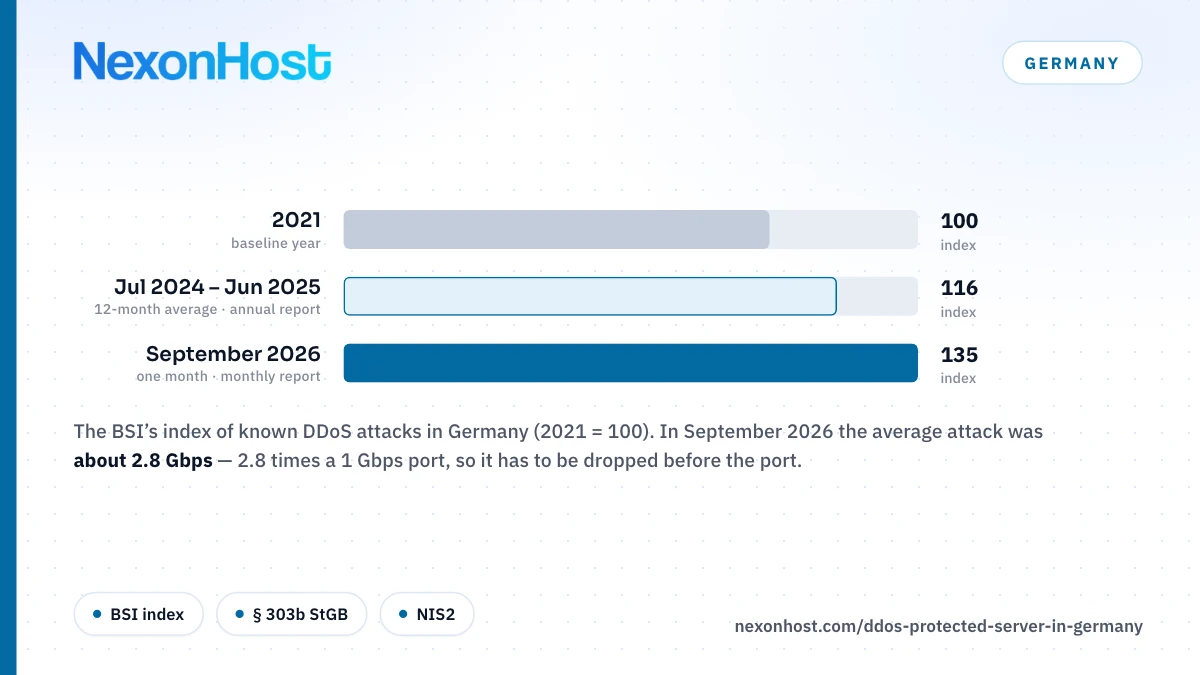
The Federal Office for Information Security (BSI) publishes an annual report, Die Lage der IT-Sicherheit in Deutschland. The current edition is 2025, presented on 11 November 2025 and covering July 2024 to June 2025; it was still the latest on 26 October 2026, and a new edition appears each November. Its DDoS figures count every DDoS attack recorded in Deutsche Telekom's network (AS3320), so they describe Germany, not the whole internet.
- Count. An index of known attacks (2021 = 100) averaged 116, rising sharply in the first half of 2025: the longest stretch of significantly raised numbers since records began.
- Election spike. Between the Bundestag election and the Munich Security Conference, both in February 2025, there were 52% more attacks than the long-term average.
- Size. Average attack bandwidth trended down, back to the level of previous years. The BSI says this figure can guide how you size network connections and protection.
- Hacktivism. The pro-Russian group NoName057(16) floods websites with HTTP and HTTPS requests; German victims include state institutions, media, transport and finance. Of the attacks the BSI monitored, 19% made the web server unavailable while they lasted; 29% had no effect.
The monthly situation report is newer. For September 2026 the BSI puts the index at 135, 1.35 times the 2021 average (down on August, within a rise since July), and the average attack at about 2,833 Mbit/s. That is 2,833 ÷ 1,000 = 2.8 times a 1 Gbps port, so on that port even an average attack has to be dropped before it arrives, not on the server. It also notes that municipalities and small and medium-sized businesses can end up on the hacktivists' target list.
The hacktivist floods are aimed at websites
Those floods are HTTP requests: Layer 7. Filtering at Layers 3 and 4, included with every NexonHost server and VPS, cannot reliably tell a request flood over real connections from real visitors. For a website, there is the 10 Tbps tier, the only server tier with Layer 7 filtering, at €4,499 a month, or the website DDoS protection proxy, from €49 a month (3 TB of clean traffic, 10 Gbps Layer 4), in front of an origin at any host. It carries HTTP(S) only, not game, VoIP, VPN or DNS traffic.
The law: § 303b StGB and NIS2
This is background, not legal advice.
§ 303b StGB, computer sabotage
§ 303b of the Criminal Code punishes anyone who significantly disrupts data processing of substantial importance to another by one of three acts, one of which is entering or transmitting data with intent to cause another a disadvantage. The penalty is up to three years' imprisonment or a fine; up to five years or a fine where the processing is of substantial importance to another's business, company or a public authority; six months to ten years in especially serious cases of that kind. Attempts are punishable. The government's 2006 explanatory memorandum for the "entering or transmitting" act (Bundestag printed paper 16/3656) gives denial-of-service attacks as an example. So an attack on your service can be an offence you report to the police: keep timestamped logs, and ask any provider what attack data it can give you.
NIS2: the reporting clock
Germany's NIS-2 implementation act was promulgated on 5 December 2025 (BGBl. 2025 I Nr. 301) and has been in force since 6 December 2025. Its Article 1 replaces the BSI Act (BSIG) with a new one, which covers, among others, companies in listed sectors above thresholds for staff, turnover and balance sheet; each company must check for itself whether it is in scope. The BSI puts supervised entities at about 29,500, against about 4,500 regulated before.
For those companies, the BSIG counts an event that impairs a service's availability as a security incident, and a significant one if it causes, or could cause, serious operational disruption or financial loss, or considerable damage to others. Section 32 sets the clock for a significant incident: an early warning within 24 hours of becoming aware, a report with a first assessment of severity and impact within 72 hours, a final report at the latest a month after that. The duty is your company's, not your host's. So ask what a provider tells you during and after an attack, and how fast.
The BSI list of qualified mitigation providers
The BSI publishes a list of qualified DDoS mitigation providers, compiled mainly for critical-infrastructure operators; the version of 15 May 2026 names 24 providers, each vetted through a documentation review and a multi-hour interview at the BSI built on fictional scenarios. NexonHost is not on it. If an auditor or contract requires a listed provider, buy from the list.
Two points help any buyer. The BSI deliberately does not rate bandwidth, because attack bandwidths keep changing and the capacity needed depends on the target, so agree it with the provider. And the features it compares make a good question list: 24/7 reachability, redundant connectivity, IPv4 and IPv6, filters for web, email, VPN and DNS, your own allowlists or geo-blocks, and the option to keep diverted traffic in German or EU data centres.
What a DDoS protected server in Germany is at NexonHost
Frankfurt is one of NexonHost's 12 dedicated server cities, and the VPS store has a Germany region alongside the Netherlands and Romania. Every dedicated server and VPS includes 100 Gbps of Layer 4 protection, and the same ladder rises to 500 Gbps (€149 a month), 1 Tbps (€499), 2 Tbps (€999), 5 Tbps (€2,499) and 10 Tbps with Layer 7 (€4,499), per server or VPS.
The DDoS protected dedicated server page says floods are "dropped upstream, before they reach your port", and that the included tier covers "UDP, ICMP and amplification floods, SYN floods and connection exhaustion". The DDoS mitigation services page lists mitigation in Germany, the Netherlands and Romania. Neither says which location filters a given server's traffic, so if a contract needs filtering inside Germany, ask before you order.
Frankfurt dedicated, Germany VPS or EPYC
All four include the same 100 Gbps of Layer 4 protection; hardware, port and delivery time differ.
| Option | From, a month | Port and traffic | Best fit |
|---|---|---|---|
| Frankfurt, 2× Xeon E5-2630 v4, 128 GB | €129 | 1 Gbps unmetered, up to 20 Gbps | A whole machine, no neighbours; ships in minutes |
| Germany VPS NEX1, 1 vCPU, 2 GB | €9 | 4 TB at 10 Gbps | Small services where 4 TB a month is ample |
| Germany VPS UNEX1, 1 vCPU, 2 GB | €18 | Unmetered at 1 Gbps | Steady traffic, no quota to watch |
| Frankfurt, AMD EPYC 9254, 128 GB | €449 | 1 Gbps; 2× 25 Gbps NIC, ports to 50 Gbps | Heavy clean traffic; order ahead, about 2 weeks |
How protection and port interact on a VPS is covered in VPS DDoS protection. Distances to German cities, and Frankfurt versus Amsterdam, are in the Frankfurt dedicated server guide.
Data residency: what Germany does and doesn't settle
The GDPR does not require German, or even EU, hosting; its Chapter V restricts transfers to third countries. A Germany-only requirement usually comes from a contract or a sector rule, and then a Frankfurt server can meet it where Amsterdam would not, if backups, support access and filtering stay there too. The BSI list notes that during mitigation, traffic flows through the provider's data centres, sometimes with TLS terminated there. EU data residency lists the questions to ask.
When Germany is the wrong place
- Your users are elsewhere. Physical floors at about 200 km per millisecond in fibre (real routes are longer; these are not NexonHost latencies): Frankfurt to London is 638 km, 3.2 ms one way, 6.4 ms round trip; to Stockholm 1,187 km, 5.9 and 11.9 ms; to New York 6,203 km, 31.0 and 62.0 ms. For a mainly US audience, start in Ashburn; choosing a European server location compares the rest.
- One city is a single point of failure you can't accept. See multi-region dedicated servers.
- Your contract requires a BSI-listed mitigation provider.
Ordering a DDoS protected server in Germany
A DDoS protected server in Germany from NexonHost is a dedicated server in Frankfurt from €129 a month or a Germany-region Linux VPS from €9 a month, each with 100 Gbps of Layer 4 protection included and paid tiers on the DDoS protected dedicated server page. Websites facing HTTP floods add the proxy or the 10 Tbps tier. Start on a one-month term.
Prices as of 26 October 2026, in euros excluding VAT. Check the product page before you order.
Sources
- BSI — The State of IT Security in Germany 2025: DDoS attacks (July 2024 to June 2025: index 2021 = 100 averaging 116, 52% above the long-term average in February 2025, falling average bandwidth, AS3320 survey basis), retrieved 26 October 2026.
- BSI — The State of IT Security in Germany 2025: Adverse impacts caused by DDoS hacktivism (HTTP/HTTPS floods, victim sectors, 19% unavailable, 29% no effect), retrieved 26 October 2026.
- BSI — Die Lage der IT-Sicherheit in Deutschland, report page (2025 is the current edition; the report appears once a year in November), retrieved 26 October 2026.
- BSI — press release of 11 November 2025 presenting the 2025 annual report, retrieved 26 October 2026.
- BSI — monthly report "IT-Sicherheitslage", threats, September 2026 (index 135, down 33% on August, rise since July 2026; about 2,833 Mbit/s average; municipalities and SMEs on target lists), retrieved 26 October 2026.
- BSI — Liste qualifizierter DDoS-Mitigation-Dienstleister, status 15 May 2026 (PDF: 24 providers, procedure in chapter 2, bandwidth not rated and compared features in chapter 4), retrieved 26 October 2026.
- § 303b StGB — Computersabotage, gesetze-im-internet.de (Federal Ministry of Justice), retrieved 26 October 2026.
- Bundestag printed paper 16/3656 — government bill on computer crime, 30 November 2006 (memorandum to § 303b(1) no. 2 citing denial-of-service attacks), retrieved 26 October 2026.
- BGBl. 2025 I Nr. 301 — Gesetz zur Umsetzung der NIS-2-Richtlinie, promulgated 5 December 2025 (Article 1: new BSIG, § 2 nos. 11 and 40, § 32 reporting deadlines; Article 29: old BSIG lapses; Article 30: in force the day after promulgation), retrieved 26 October 2026.
- BSI — press release of 5 December 2025, NIS-2 implementation act in force from 6 December (scope thresholds, self-assessment, about 29,500 and about 4,500 entities), retrieved 26 October 2026.
- Regulation (EU) 2016/679 (GDPR), Official Journal text via the EU Publications Office (Chapter V, Article 44: transfers to third countries), retrieved 26 October 2026.
- NexonHost — DDoS protected dedicated servers (site copy quoted above), retrieved 26 October 2026.
- NexonHost — DDoS mitigation services (mitigation listed in Germany, the Netherlands and Romania), retrieved 26 October 2026.
- NexonHost store, retrieved 26 October 2026: DDoS tiers and prices, Frankfurt Xeon and EPYC builds, port prices, delivery times, Germany-region VPS plans, website protection proxy plans.
- Computed: 2,833 ÷ 1,000 = 2.8; haversine great-circle distances (R = 6,371 km) from city-centre coordinates (Frankfurt 50.1109 N, 8.6821 E; London 51.5074 N, 0.1278 W; Stockholm 59.3293 N, 18.0686 E; New York 40.7128 N, 74.0060 W); one-way floor = distance ÷ 200 km/ms, round trip = 2 × one way (638 km: 3.2 and 6.4 ms; 1,187 km: 5.9 and 11.9 ms; 6,203 km: 31.0 and 62.0 ms).