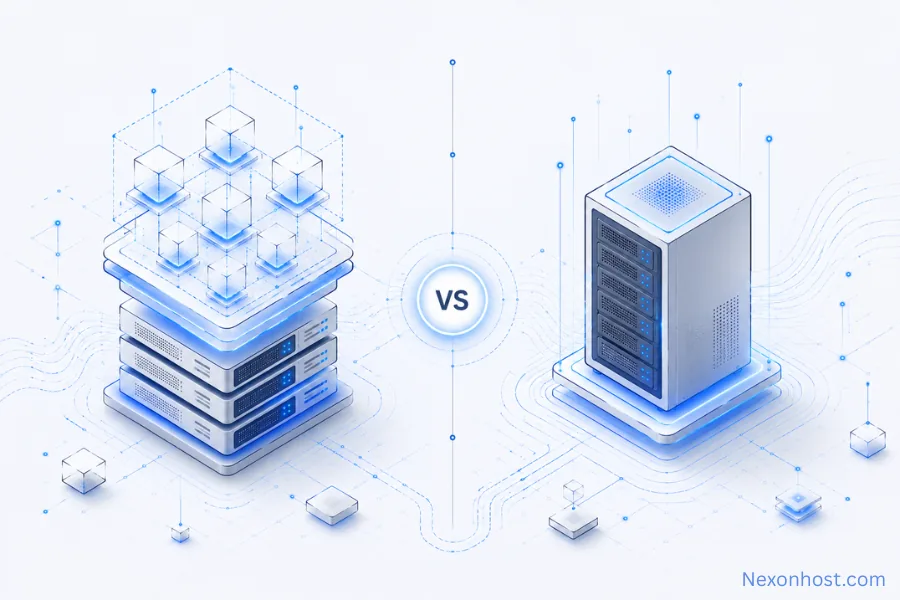
Moving from shared hosting to VPS is usually sold as a performance upgrade. That is the least interesting thing about it, and often not even true — a well-tuned site on good shared hosting beats a badly configured VPS every time.
What you are actually buying is isolation and control: guaranteed resources that a noisy neighbour cannot take, and root access that lets you install and configure anything. Both of those are genuinely valuable. Both also transfer responsibility from your host to you, and that transfer is the part people fail to price in.
Here is how to tell whether you are ready, with the numbers rather than the marketing.
What actually changes
| Shared hosting | VPS | |
|---|---|---|
| Resources | Pooled, variable | Allocated to you |
| Root access | No | Yes |
| Software you can install | What the host offers | Anything |
| PHP / database versions | Host's choice | Yours |
| Who patches the OS | The host | You, unless managed |
| Who configures the firewall | The host | You |
| Noisy neighbour risk | Real | Largely removed |
| Blast radius of your mistake | Small | The whole server |
The last two rows are the trade. You stop being affected by other people's problems and start being fully exposed to your own.
Five signals it is genuinely time
1. You are hitting resource limits, not speed limits. Look for the specific errors: process or entry-process limits, memory exhaustion, concurrent connection caps, "resource limit reached" pages under load. These are ceilings the host imposes, and no amount of optimisation removes them. This is the strongest signal there is.
2. You need software the host will not install. Redis or Valkey, a specific PHP extension, a background worker, a queue, Node alongside PHP, a cron running every minute rather than every fifteen. If your architecture requires something the control panel does not offer, the argument is over.
3. You need a version the host does not offer. Platform requirements have moved fast: current WordPress asks for PHP 8.3 or greater with MariaDB 10.11+ or MySQL 8.0+, Magento Open Source 2.4.9 asks for PHP 8.5, and PrestaShop 9.1 supports PHP 8.2 to 8.5. If your host is still on PHP 8.1, you are not upgrading your store this year.
4. Compliance or isolation requirements. Anything requiring you to state who else can reach the filesystem, or to control your own encryption and logging, has effectively outgrown a shared environment.
5. Background work is the bottleneck. Image processing, report generation, imports, anything long-running. Shared hosting kills long processes by design, and that is not a bug you can work around.
Three reasons that are not good enough
"The site is slow." Measure before you move. Most slow sites are slow because of unoptimised images, render-blocking scripts, missing database indexes or a plugin doing something expensive on every request. A VPS makes all of those exactly as slow, and now you maintain the operating system too.
"VPS sounds more professional." Nobody can tell. Your customers cannot see your hosting tier.
"I am close to my disk quota." Buy more disk. That is a smaller change than an architecture migration.
What it costs, honestly
Real figures from the NexonHost price list as of September 2026, annual billing:
| Plan | Resources | Annual billing | Monthly |
|---|---|---|---|
| Web Hosting Essential | 25 GB SSD, 250 GB bandwidth, 1 site | — | €2.99 |
| Web Hosting Business | 50 GB SSD, 500 GB bandwidth, 10 sites | — | €5.99 |
| Web Hosting Professional | 100 GB SSD, unlimited bandwidth, unlimited sites | — | €13.99 |
| VPS NEX1 | 1 CPU, 2 GB RAM, 40 GB NVMe, 4 TB bandwidth | €8.10 | €9 |
| VPS NEX2 | 2 CPU, 4 GB RAM, 60 GB NVMe, 8 TB bandwidth | €16.20 | €18 |
| VPS NEX3 | 4 CPU, 8 GB RAM, 80 GB NVMe, 16 TB bandwidth | €28.80 | €32 |
| Unmetered VPS UNEX1 | 1 CPU, 2 GB RAM, 40 GB SSD, 1 Gbps unmetered | €16.20 | €18 |
The entry VPS at €8.10 a month costs more than Essential shared hosting and less than Professional. So the money is rarely the obstacle. The obstacle is the forty minutes of setup and the ongoing maintenance, which do not appear on any price list.
Metered or unmetered: a real decision, not an upsell
Notice that NEX2 and UNEX1 are the same price on annual billing — €16.20 a month — and buy very different things.
NEX2 gives you twice the CPU, twice the memory and 8 TB of monthly transfer. UNEX1 gives you the smaller machine with no transfer quota at all on a 1 Gbps port.
So the question is which ceiling you will meet first. Eight terabytes is a great deal of traffic for a normal website — at the October 2024 median mobile page weight of 2,311 KB, 8 TB is roughly 3.5 million pageviews. If you are nowhere near that, take the bigger machine. If you serve video, downloads or backups, the quota is the thing that will stop you and the unmetered Linux VPS is the right side of the trade.
Work out which you are before choosing: the method is in how much bandwidth a server needs, and the billing models are compared in unmetered bandwidth vs metered.
The cost that is not on the price list
On day one of a VPS you own the operating system. Updates, firewall, SSH configuration, backups, monitoring, TLS renewal — all yours. Budget the first hour properly; the new server security checklist is what that hour looks like.
If that is not work you want, it can be bought rather than learned: infrastructure management covers it, and managed vs unmanaged server hosting sets out where the line falls. A managed VPS costs more than an unmanaged one and less than an outage.
When to skip the VPS entirely
Two cases where going from shared hosting to VPS is the wrong move.
Your database is the constraint. Write-heavy workloads — busy checkouts, large catalogues, heavy reporting — want real cores and real disk, not a slice of them. Go to bare metal instead; NexonHost dedicated builds start at €129 a month with 20 cores and 128 GB of memory.
You are already planning to split tiers. If the architecture is heading for a separate database server anyway, one migration is better than two.
Otherwise the ladder is the right shape: shared hosting until you hit a ceiling you can name, then a Linux VPS, then dedicated hardware when the VPS runs out. Each step should be triggered by a measurement, not a feeling. If you cannot name the limit you are hitting, you have not found it yet.
Pricing is as of September 2026 — check web hosting and the VPS pages for current figures.
Sources
- WordPress requirements, WordPress.org. Retrieved 21 September 2026.
- Adobe Commerce system requirements, Adobe Experience League. Retrieved 21 September 2026.
- System requirements for PrestaShop 9, PrestaShop Developer Documentation. Retrieved 21 September 2026.
- Web Almanac 2024 — Page Weight, HTTP Archive. Median mobile page weight measured October 2024. Retrieved 21 September 2026.
- NexonHost pricing from the web hosting, Linux VPS and unmetered Linux VPS pages. Retrieved 21 September 2026.