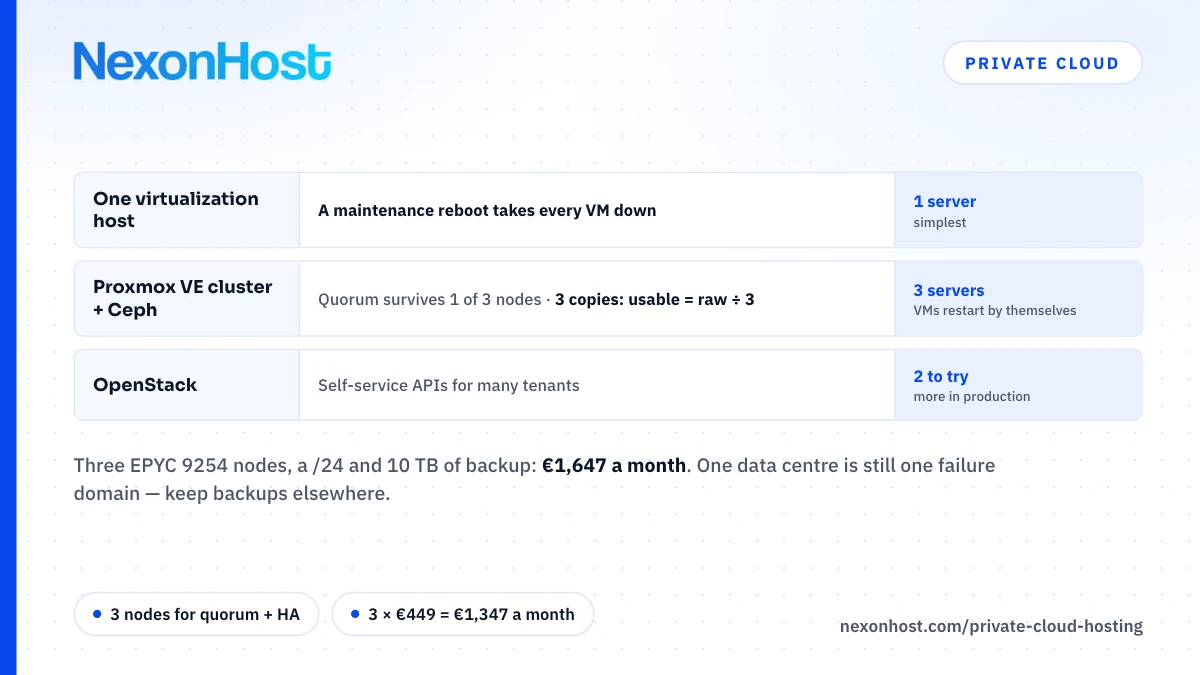
One server running a hypervisor is a virtualization host. A private cloud is several servers acting as one pool, so a dead node's VMs restart elsewhere without anyone moving them. For private cloud hosting on rented dedicated servers, the minimum is set by quorum and replication, not by your VM count.
If you only need one host, Proxmox on a dedicated server covers sizing and licensing.
Why the minimum is three nodes
A Proxmox VE cluster stays consistent by voting. Each node has one vote, changes need a majority, and a cluster that loses quorum goes read-only. With two nodes, losing one leaves one vote of two: no majority. With three, two of three remain, and the cluster carries on.
That is why the Proxmox cluster manager docs say that for high availability "you need to have at least three nodes for reliable quorum". For two nodes they offer a QDevice, a vote daemon on a separate host; Proxmox supports it for even node counts and discourages it for odd ones. The HA manager also requires shared storage and redundant, reliable hardware.
Proxmox gives "typical error detection and failover times of about 2 minutes". HA restarts a failed node's VMs elsewhere; it does not keep them running. First the failed node is fenced: a watchdog (hardware if configured, otherwise the kernel's softdog) reboots it, so no VM runs on two nodes at once.
Shared storage: Ceph on three nodes
HA needs storage every node can reach. The option built into Proxmox is Ceph on the same servers, which Proxmox calls hyper-converged. The rules that size it:
- Three monitors. Ceph works only while a majority of monitors agree, and its docs recommend at least three, in an odd number.
- Three copies. A replicated pool's default
sizeis 3, and Proxmox creates pools withmin_size2: writes continue with one copy missing. - Usable = raw ÷ 3, and less in practice. Ceph's default nearfull warning, which Proxmox's docs repeat, is at 85%, and Ceph stops I/O at the full ratio, 95% by default.
- One OSD per disk. An OSD is Ceph's per-disk daemon; Proxmox says to avoid RAID controllers.
- At least 12 OSDs, spread evenly over at least three nodes, Proxmox recommends.
Now a real build. The AMD EPYC 9254 (24 cores, 128 GB DDR5) ships with 2× 1 TB NVMe in RAID 1. That pair is a boot mirror. Kept as shipped, it leaves zero disks for Ceph.
Splitting the pair is not a checkout option. If sales agree to deliver it unmirrored, you could install Proxmox on one disk and give Ceph the other, at the cost of the boot mirror. The arithmetic for that, and for a hypothetical layout with four extra drives per node:
| Per cluster | Split boot pair: 1× 1 TB OSD per node | Hypothetical: 4× 1.92 TB OSD per node |
|---|---|---|
| Raw | 3 × 1 TB = 3 TB | 3 × 4 × 1.92 TB = 23.04 TB |
| Usable at size 3 | 3 ÷ 3 = 1 TB | 23.04 ÷ 3 = 7.68 TB |
| Kept under 85% | 0.85 TB | about 6.5 TB |
| OSDs vs Proxmox's 12 | 3 | 12 |
One terabyte is small for three EPYC servers, and three OSDs is a quarter of Proxmox's recommendation. With three hosts and three copies, a failed node also leaves nowhere to rebuild the missing copy: the pool runs degraded on two until the node returns.
NexonHost's virtualization page says 1.92 TB enterprise NVMe drives can be added to the EPYC builds, but the store has no option or price for them, so the right column is an assumption, not a product. Ask sales how many fit the EPYC 9254, what they cost, and whether the boot pair can be split.
Ceph also takes memory and cores: Proxmox recommends at least 8 GiB per OSD and one core per Ceph service, and four to six threads per fast NVMe OSD is likely. In the four-drive layout, four OSDs take about 4 × 8 = 32 GiB of a node's 128 GB, leaving at most about 96 GB for guests before the monitor, manager and Proxmox itself. To survive a node failure, VMs must fit on the other two: about 2 × 96 = 192 GB of guest RAM across the cluster, not 3 × 96 = 288.
The network the projects ask for
A cluster carries three kinds of traffic, and the docs want them apart:
- Corosync needs latencies "under 5 milliseconds (LAN performance)". It uses little bandwidth, but Proxmox recommends a dedicated physical NIC and warns: "do not use a shared network for corosync and storage". A dedicated 1 Gbit NIC is enough in most cases.
- Ceph needs at least 10 Gbps used only by Ceph, says Proxmox, and at least 25 Gbps when OSDs are NVMe, because one NVMe drive can fill 10 Gbps on its own.
- VM and public traffic goes on the uplink.
Ceph's own docs ask for at least 10 Gb/s between hosts and say busy clusters do well with 25 Gb/s. Speed is safety: Ceph puts re-replicating 1 TiB at 3 hours over 1 Gb/s against 20 minutes over 10 Gb/s, and a second failure inside that window can make data unavailable or lost.
The EPYC 9254's NIC is 2× 25 Gbps SFP28, but the included port is 1 Gbps. The store's port options are bandwidth tiers: a guaranteed 25 Gbps port costs €1,875 a month instead of €80, so each node would be €369 + €1,875 = €2,244, or €6,732 a month for three. That buys uplink speed; the store sells neither the second SFP28 port nor a network used only by Ceph. NexonHost's dedicated servers page lists a "Private VLAN" add-on with no speed or price: ask sales whether your build can have one, on which port, at what price, in writing. Order all three nodes in one facility, as the virtualization page advises.
What the minimum cluster costs
Prices as of 9 November 2026, EUR excluding VAT, from the store:
| Line | Calculation | A month |
|---|---|---|
| 3× EPYC 9254, 1 Gbps port each | 3 × €449 | €1,347 |
| /24 for VM addresses | €250, plus €100 setup once | €250 |
| Backup storage, 10 TB | flat tier | €50 |
| Total | 1,347 + 250 + 50 | €1,647 |
The first month adds the €100 /24 setup: €1,747. Extra Ceph drives and a private network have no store price and are not included; ask sales. EPYC builds take about two weeks. To learn clustering first, three 2× Xeon E5-2630 v4 servers (20 cores, 128 GB each) cost 3 × €129 = €387 a month and provision in minutes; each ships with one 240 GB SSD, so add disks. Against hourly instances, see bare metal vs cloud cost.
Addresses for the VMs
Each server includes one IPv4 address; up to five extra cost €3 each a month, and a /24 is €250 a month plus €100 setup. Announcing your own /24 is covered in bring your own IP.
One cluster-specific question: when HA moves a VM, its address has to work on the new node. Ask whether the /24 can be routed to all three servers, or only to one.
Proxmox cluster, OpenStack, one host or public cloud
OpenStack calls itself "a cloud operating system" for large pools of compute, storage and networking. Its install guide's example needs at least two nodes and is "not intended for production"; Kolla Ansible's quick start asks for at least 8 GB of memory and two network interfaces on the host, and the HA guide for an odd number of nodes per cluster. For a few dozen VMs and no team to run it, a Proxmox cluster is the smaller tool.
| Option | Minimum servers | Fits when |
|---|---|---|
| One virtualization host | 1 | A maintenance reboot can take every VM down |
| Proxmox VE cluster + Ceph | 3 | VMs must restart on another node by themselves |
| OpenStack | 2 to try, more in production | Many tenants need self-service APIs |
| Public cloud | None | Load is spiky, or you want managed services |
For containers rather than VMs, read Kubernetes on bare metal. If you want to sell the VMs, starting a VPS hosting business covers the panel, IPs and abuse duties.
What a private cloud does not solve
One facility is one failure domain. Corosync's under-5 ms requirement, and the advice to order nodes in one facility, put all three nodes in one building, so an event there takes the whole cluster and all three Ceph copies. For a second site, replicate to a separate cluster.
Replication is not backup. Delete a VM disk by mistake and Ceph removes all three copies at once. Keep backups off the cluster: offsite backup storage covers the design, and NexonHost's backup storage starts at €5 a month for 1 TB.
Someone has to run it. Upgrades, Ceph warnings and failed disks are yours. NexonHost sells 2 hours a month of hands-on help for €99, or fully managed (12 hours a month) for €599; managed vs unmanaged hosting helps decide.
Private cloud hosting at NexonHost
For private cloud hosting on your own Proxmox cluster, start on the virtualization servers page. It lists Proxmox VE 7, 8 and 9 at checkout and quotes multi-node clusters; you build the cluster and Ceph yourself. Infrastructure as a service shows where it fits with VPS, storage and backup, and every build is on dedicated servers. Each server includes 100 Gbps of Layer 3/4 DDoS protection. Start on a one-month term, pull a node on purpose, and time how long its VMs take to return. Prices are as of 9 November 2026; check the product pages for current figures.
Sources
- Proxmox VE Cluster Manager — admin guide v9.2.13: requirements, quorum, QDevice, network requirements, retrieved 9 November 2026
- Proxmox VE High Availability — HA requirements, failover time, fencing and watchdog, retrieved 9 November 2026
- Proxmox VE Deploy Hyper-Converged Ceph Cluster — node, OSD, memory, CPU and network recommendations, pool defaults, nearfull 85%, retrieved 9 November 2026
- Ceph Pool, PG and CRUSH Config Reference — osd_pool_default_size default 3, retrieved 9 November 2026
- Ceph Adding/Removing Monitors — at least three monitors, majority, odd number, retrieved 9 November 2026
- Ceph Monitor Config Reference — default full ratio 0.95, retrieved 9 November 2026
- Ceph Network Sizing — link speeds and recovery time by link speed, retrieved 9 November 2026
- Ceph Network Configuration Reference — public vs cluster network, retrieved 9 November 2026
- OpenStack Software — what OpenStack is, retrieved 9 November 2026
- OpenStack Installation Guide overview — example architecture, two-node minimum, not for production, retrieved 9 November 2026
- Kolla Ansible quick start — host machine minimum requirements, retrieved 9 November 2026
- OpenStack HA Guide key concepts — clusters and quorums, retrieved 9 November 2026
- NexonHost virtualization servers — EPYC extra-NVMe line, multi-node quotes, same-facility cluster advice, retrieved 9 November 2026
- NexonHost dedicated servers — builds and the Private VLAN add-on listing, retrieved 9 November 2026; port, IP, backup and management prices from the NexonHost store, read 9 November 2026