Bring your own IP addresses to a dedicated server and they stay yours when you change provider, along with their reputation, allowlists and DNS records. The price is paperwork: you must hold the block, publish which network may announce it, and keep an abuse contact someone reads. This guide covers what you need for your own /24 (optionally with your own AS number), what it costs on a NexonHost server over 12 and 24 months, and when renting addresses is simpler.
Why teams bring their own IP space
Three reasons come up most:
- Reputation and allowlists. Mail sender reputation, partner firewall allowlists and VPN peers that pin your addresses attach to the IP, not to your company. New addresses carry none of your history, and sometimes someone else's.
- More than one provider. Announcing the same /24 through several providers, for failover or anycast, only works with addresses you control. Multi-region dedicated servers covers when that design is worth it.
- Renumbering pain. Every hard-coded address in customer configurations, licence servers and monitoring changes when you move. With your own block, only the provider changes.
Where a /24 comes from in 2026
Europe's registry, the RIPE NCC, ran out of IPv4 on 25 November 2019. New allocations now come only from space it recovers, through a first-come-first-served waiting list under the current policy (ripe-826): exactly one /24 per LIR, and only for LIRs that have never received an IPv4 allocation from the RIPE NCC. On 19 October 2026, RIPE's waiting-list page showed 800 LIRs in the queue, the one at the front waiting 483 days.
Becoming an LIR costs a €1,000 sign-up fee plus an annual fee per account: €1,800 in 2026, rising to €1,894 in 2027, when the account's first AS number is included and each extra one costs €50. The alternative is the transfer market, which RIPE acknowledges but does not price; we quote no market prices.
Why a /24? It is 256 addresses (/24 versus /27 explains the arithmetic) and the longest IPv4 prefix the internet reliably carries. RFC 7454 (2015), the IETF's BGP operations best practice, records the RIPE community's finding that IPv4 prefixes longer than /24 were then generally neither announced nor accepted. A /25 on its own is likely to be dropped by many networks.
What each IP option costs on a NexonHost server
Every dedicated server includes one IPv4 address. The configurator offers four ways to add more, as add-ons to a server order (as of 19 October 2026, EUR excluding VAT):
| Option | Setup + monthly | 12 months | 24 months |
|---|---|---|---|
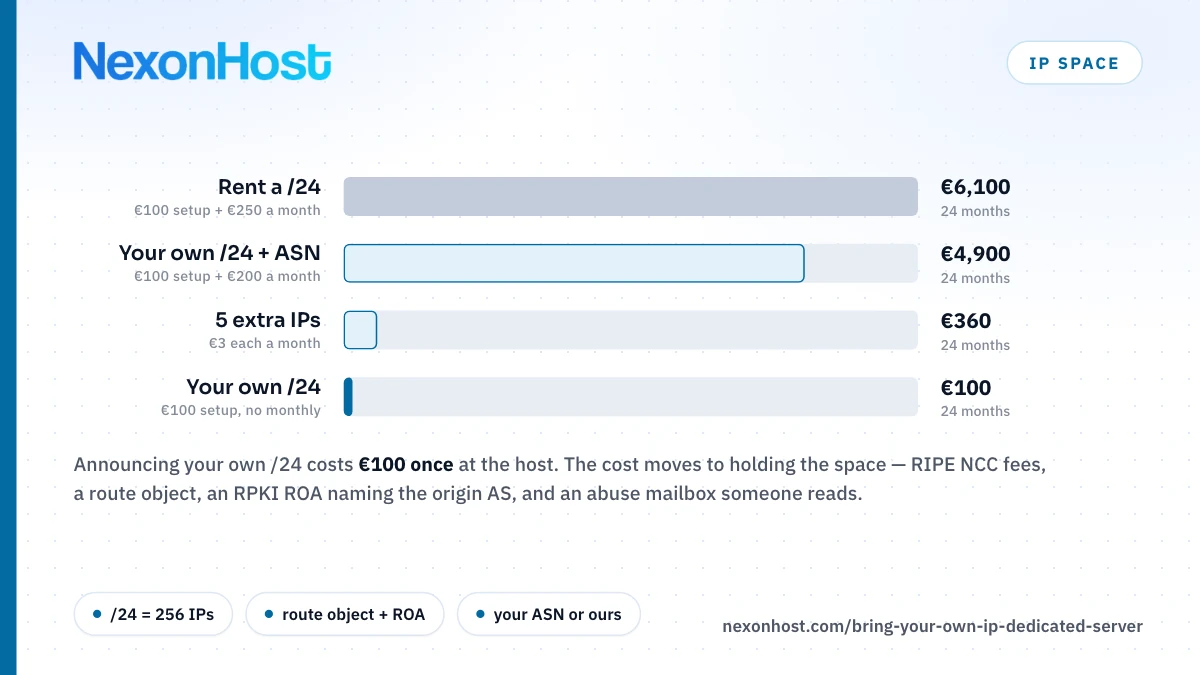
| 5 extra IPs at €3 | €0 + €15 | €180 | €360 |
| Rent a /24 from NexonHost | €100 + €250 | €3,100 | €6,100 |
| Your own /24 | €100 + €0 | €100 | €100 |
| Your own /24 + ASN | €100 + €200 | €2,500 | €4,900 |
The sums: 5 × €3 = €15 a month. A rented /24 is €100 + 12 × €250 = €3,100, or €100 + 24 × €250 = €6,100. Your own /24 plus ASN is €100 + 12 × €200 = €2,500, or €100 + 24 × €200 = €4,900.
Two things stand out. Nothing sits between six addresses (one included plus five) and 256. And a rented /24 works out at €250 ÷ 256 ≈ €0.98 per address a month, about a third of the single-IP price, if you use most of it.
Your own block is the cheap line on the NexonHost side: €100 once. The cost moves to holding the space. A new LIR pays €1,000 + €1,894 = €2,894 for its first full year at 2027 rates, close to a year of rented /24, and then joins the queue above. Your own space pays off when you already hold it, or will use it with more than one provider.
The paperwork before anyone announces your prefix
Either way, these records must exist first:
- You hold the space. The block is registered in the RIPE Database, as an inetnum object, to you or to whoever lends it to you. Only that holder can authorise the steps below.
- A route object. It pairs your prefix with the AS number that originates it, and needs the address holder's authorisation, not the AS holder's. RFC 7454 describes networks building prefix filters from these entries, so a missing route object can get you filtered.
- An RPKI ROA. A Route Origin Authorisation is a signed statement that one AS may originate your prefix (RFC 9582, which replaced RFC 6482). Networks running origin validation (RFC 6811) mark each route Valid, Invalid or NotFound against it. Keep the maximum length at 24 for a /24: RFC 9319 and the RIPE NCC discourage longer ones, because the unannounced more-specifics they authorise can be hijacked by forging your origin AS.
- A Letter of Authorisation. Providers commonly ask for a signed letter from the registered holder naming the prefix and the AS allowed to announce it. Ask NexonHost which wording it needs.
- An abuse contact. RIPE policy (ripe-705) requires an abuse-c on every directly allocated inetnum and every aut-num, pointing to a mailbox the RIPE NCC validates at least once a year. Whois for your addresses shows your mailbox, so complaints come to you.
Who announces it: the two store options
Your own /24 (€100 setup). No AS number of yours is involved, so the provider's side originates the prefix. NexonHost's own network is AS62390, which peers at AMS-IX in Amsterdam; confirm which AS will originate your prefix in the city you pick, because your route object and ROA must name it. RIPE's RPKI documentation notes that the origin AS need not belong to the address holder; that is what lets a provider announce for you.
Your own /24 + ASN (€200 a month + €100 setup). Your AS number is the origin and NexonHost carries the route, so the ROA and route object name your ASN, which needs its own aut-num object and abuse-c. RIPE's AS number policy (ripe-679) says a network must be multihomed to qualify for one, so plan a second upstream or peering besides NexonHost.
The store text does not say how the announcement is made: a BGP session between NexonHost and a router you run on the server, or NexonHost announcing the prefix for you with your ASN as origin. Confirm which, and that your ASN will be the origin, before you sign the ROA; the wrong origin makes your route Invalid wherever origin validation runs.
Moving a prefix without a gap
Your addresses survive a move, but the cutover is where ROAs bite. A ROA for one origin makes every other origin Invalid, and the RIPE NCC's advice for a prefix announced from several ASes is a ROA for each. So:
- Add a ROA and route object for the new origin while the old ones still stand.
- Bring the announcement up at the new provider and check that it is visible.
- Ask the old provider to withdraw, then delete the old ROA and route object.
The addresses do not change, so DNS does not either. If you are moving to new addresses instead, migrating a server without downtime covers the DNS side.
When renting addresses is simpler
Don't bring your own block if:
- You need six addresses or fewer. One included plus five at €3 is €15 a month.
- You don't hold space and need it soon. With 800 LIRs queued and the front of the queue at 483 days on 19 October 2026, the waiting list is not a plan for this quarter.
- You expect to stay with one provider. Portability is most of the value; a rented /24 (€3,100 in the first year) leaves the registry work to the provider.
- Nobody will watch the abuse mailbox. Unanswered reports against your own space are your problem, not your provider's.
Questions to ask before you order
- Which AS originates my /24 in my city, and with my own ASN, do I get a BGP session?
- Can one prefix be announced from servers in several cities, and is the option charged per server?
- Which Letter of Authorisation wording do you need, and how long until the prefix is live?
- Does the included 100 Gbps DDoS protection cover my own prefix?
- What happens to the announcement if the server is cancelled?
- Can you route my IPv6 prefix too?
Where to start
To bring your own IP space to NexonHost, pick a build on dedicated servers, from €129 a month with a 1 Gbps unmetered port and one IPv4 address included, and choose "Your own /24" or "Your own /24 + ASN" in the configurator. Prepare the route object, ROA and Letter of Authorisation, and send the questions above through contact us before ordering. The bare-metal hub lists the other server families. If you don't hold space, rent it and start on a one-month term.
Prices as of 19 October 2026, in EUR excluding VAT; check the product page before ordering.
Sources
- The RIPE NCC has run out of IPv4 Addresses — RIPE NCC announcement, 25 November 2019, retrieved 19 October 2026
- What is IPv4 run-out — RIPE NCC (run-out dates; transfer market), retrieved 19 October 2026
- IPv4 Waiting List — RIPE NCC (800 LIRs in queue, first LIR waiting 483 days on 19 October 2026), retrieved 19 October 2026
- ripe-826 — IPv4 Address Allocation and Assignment Policies for the RIPE NCC Service Region, section 5.1, retrieved 19 October 2026
- ripe-848 — RIPE NCC Charging Scheme 2026 (€1,800 annual fee, €1,000 sign-up), retrieved 19 October 2026
- ripe-867 — RIPE NCC Charging Scheme 2027 (€1,894 annual fee, first ASN included, €50 per additional ASN), retrieved 19 October 2026
- RFC 7454 — BGP Operations and Security, sections 6.1.2.2.1 and 6.1.3, retrieved 19 October 2026
- Descriptions of Primary Objects — RIPE Database documentation (route and aut-num objects), retrieved 19 October 2026
- Protection of Route(6) Object Space — RIPE Database documentation (authorisation rules), retrieved 19 October 2026
- Using the Hosted Certification Authority — RIPE NCC RPKI documentation (ROAs, maximum length, origin validation states), retrieved 19 October 2026
- RFC 9582 — A Profile for Route Origin Authorizations (obsoletes RFC 6482), retrieved 19 October 2026
- RFC 6482 — the original ROA profile, retrieved 19 October 2026
- RFC 6811 — BGP Prefix Origin Validation, retrieved 19 October 2026
- RFC 9319 — The Use of maxLength in the RPKI (BCP 185), retrieved 19 October 2026
- ripe-705 — Abuse Contact Management in the RIPE Database, retrieved 19 October 2026
- ripe-679 — Autonomous System (AS) Number Assignment Policies, section 2.0, retrieved 19 October 2026
- PeeringDB — NEXONHOST, AS62390 (AMS-IX, 100 Gbps, route-server peer), retrieved 19 October 2026
- NexonHost store configurator, dedicated server IP options: 1 IPv4 included; extra IPs €3 each a month, up to five; /24 subnet €250 a month + €100 setup; your own /24 €100 setup; your own /24 + ASN €200 a month + €100 setup; retrieved 19 October 2026
- Computed: 5 × €3 = €15 a month; €100 + 12 × €250 = €3,100; €100 + 24 × €250 = €6,100; €100 + 12 × €200 = €2,500; €100 + 24 × €200 = €4,900; €250 ÷ 256 ≈ €0.98; €1,000 + €1,894 = €2,894