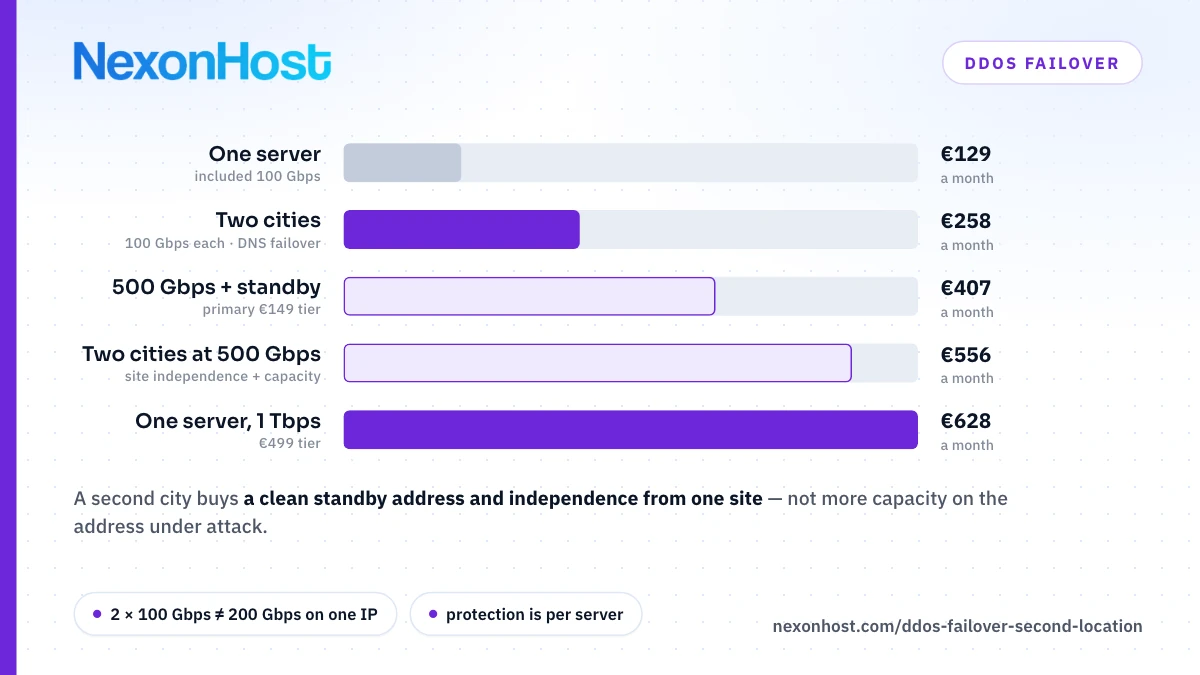
Does a second location protect you from DDoS? Partly, and not the way most buyers expect. Two servers in two cities, each with 100 Gbps of protection, are not 200 Gbps in front of one address. What a second city buys is a standby address the attacker has never seen, and independence from one site's problems. That is DDoS failover, and whether it beats a bigger tier on one server depends on how the attack finds you. At NexonHost the two options cost €258 and €628 a month.
Attacks aim at an address, a prefix or a name
Failover only moves some of these.
- An address. Volumetric floods target an IP. In a reflection attack, servers answer requests forged with your address as the source, so their replies, often many times larger, land on it. That flood ignores your DNS.
- A prefix. A carpet bombing attack spreads one flood across many addresses in a prefix, such as a whole /24. A standby in the primary's /24 can be hit too.
- A name. A tool given a hostname resolves it like any client. Change the record and, the next time it resolves, the flood follows.
DNS failover helps against the first, against the second only if the standby sits in another prefix, and merely delays the third.
What a DNS TTL actually promises
DNS failover points your hostname at the standby when the primary fails, and users follow as fast as the record's TTL allows.
RFC 1035 (section 4.1.3) defines the TTL as the seconds a record "may be cached before it should be discarded". RFC 2181, section 8, is blunter: "The TTL specifies a maximum time to live, not a mandatory time to live." A resolver holding the old answer may serve it until the TTL runs out. RFC 8767 (2020), which updates both, goes further: a resolver that cannot reach your authoritative servers may use an expired record "as though it is unexpired", and it suggests keeping stale data for one to three days.
Three consequences:
- The TTL that counts is the one resolvers already hold. With a TTL of 3,600 seconds, caches may serve the old address for up to 3,600 ÷ 60 = 60 minutes after you change it. Lowering the TTL mid-attack does not shorten that.
- Your DNS must not live where the attack lands. If the authoritative servers sit on the attacked network, you cannot publish the change, and stale answers keep pointing at the attacked address.
- Switching DNS moves users, not a flood aimed at an address. It also publishes the standby's address: anyone can resolve your name. An attacker who looks again follows. Failover buys time, not immunity.
Multi-region dedicated servers covers clients that ignore TTLs, and replication.
Why two 100 Gbps servers are not a 200 Gbps shield
Unicast addressing gives each IP one place on the internet: every packet aimed at the primary's address goes to the primary, through whatever filtering sits in front of it, and none reaches the second server. NexonHost sells protection the same way; its DDoS page says "Upgrades are billed per server, per month". So it is not 100 + 100 = 200 Gbps but 100 Gbps on whichever address is attacked, and publishing both addresses just gives an attacker two targets.
What the second location does buy, and does not:
- A clean address. A flood aimed at the primary's IP does not target a standby address that was never published, unless it fills links the two share.
- Independence from one site. A facility problem, a hardware fault or an attack above the primary's tier no longer takes the service down for longer than the switch takes. NexonHost's DDoS page tells buyers to ask any provider what happens above the tier (more filtering, a temporary null-route or an upgrade); its own answer is not published, so ask.
- Not a second provider. Two NexonHost cities are still one provider and one set of terms. The DDoS mitigation services page lists mitigation nodes in Germany, the Netherlands and Romania; where each city's traffic is filtered is not published, so ask whether your two cities share filtering.
Anycast: where locations can add up
RFC 4786, the IETF's best current practice for anycast, defines it as making one service address available in "multiple, discrete, autonomous locations": every site announces the same prefix.
Its security section gives the DDoS benefit: each node can be "a sink for attack traffic originated within its sphere of influence", and an attack from widely spread sources is shared across the nodes. Here locations can add up, but the RFC calls load distribution between nodes "coarse" and "unbalanced": the node that routing puts nearest to most attack sources can take most of the flood.
It needs a prefix every site can announce, in practice a /24 (bring your own IP covers the paperwork). The store sells a rented /24 (€250 a month + €100 setup), "Your own /24" (€100 setup) and "Your own /24 + ASN" (€200 a month + €100 setup), but announcing one /24 from more than one NexonHost city is not documented. Confirm it in writing first: ask through the contact page.
What each approach costs
Prices as of 16 November 2026, in euros excluding VAT, on the €129 Xeon build (20 cores, 128 GB of RAM, unmetered 1 Gbps port), priced the same in all twelve cities. The 500 Gbps tier is €149 a month; 1 Tbps is €499.
| Approach | Survives | Doesn't survive | Per month |
|---|---|---|---|
| One server, included 100 Gbps | L3/4 floods within 100 Gbps | Bigger floods; a site outage; HTTP floods | €129 |
| One server, 1 Tbps tier | L3/4 floods within 1 Tbps | A site outage; HTTP floods | €628 |
| Two cities, 100 Gbps each, DNS failover | A site outage; a flood on the old IP | 100 Gbps+ on the live IP; an attack that follows the name; HTTP floods | €258 |
| 500 Gbps primary, 100 Gbps standby | A site outage; floods within 500 Gbps on the primary | 100 Gbps+ once the standby is live and found; HTTP floods | €407 |
| Two cities, 500 Gbps each | A site outage; floods within 500 Gbps on either IP | Bigger floods; HTTP floods | €556 |
| One server + Micro website proxy | HTTP floods at the proxy | Non-HTTP services; a leaked origin IP; a site outage | €178 |
The sums: 129 + 499 = €628; 2 × 129 = €258; 129 + 149 + 129 = €407; 2 × (129 + 149) = €556; 129 + 49 = €178. Two cities on the included tier cost €370 a month less than one server on 1 Tbps (€628 − €258); two on 500 Gbps, €72 less (€628 − €556). The store preselects a €5-a-month 1 TB backup add-on per server, left out here. No tier publishes a packet-rate figure.
Bigger tier or second city?
Buy the bigger tier when clients connect to an address, not a name (players who add a game server by IP, SIP peers, partner allowlists): DNS failover does nothing for them. Likewise when you have measured attacks above 100 Gbps; what to do when your server is under DDoS attack covers capturing the figures.
Buy the second city when clients use a hostname, you can replicate the data, and the attacks you have seen fit the included tier.
Buy both when you need site independence and have measured floods above 100 Gbps: €556.
Neither stops an HTTP flood: every tier below 10 Tbps (€4,499 a month) filters Layers 3 and 4 only. For a website, the website DDoS protection proxy (Micro, €49 billed monthly) filters HTTP in front of an origin whose address you keep hidden (hide the origin IP). It carries HTTP(S) only, not game, VoIP or DNS traffic.
A runbook for a clean standby
- Order the standby before you need it, in a second city. Xeon builds provision automatically within minutes; EPYC builds take about two weeks.
- Keep its address unpublished: no DNS record, mail or certificate for your domain on it (the origin-IP guide lists the leaks). Until the switch, accept only replication from the primary and your monitors. Ask which /24 each address is in.
- Lower the TTL in advance, say to 300 seconds, at least one old TTL before you might need it.
- Host authoritative DNS off both servers, so you can still publish the change during an attack.
- Replicate the data; the multi-region guide has the designs.
- Health-check from outside both cities; switch on repeated failures from several vantage points, decide in advance whether a script or a person makes the call, and do not fail back mid-attack.
- After a failover, the standby's address is burned. Once the old primary is quiet, add a fresh IPv4 to it (€3 a month; ask which /24 it is in) to make it the next clean standby, and test the switch on a schedule.
Where NexonHost fits
DDoS failover at NexonHost means a second dedicated server in another of the twelve cities: Amsterdam, Frankfurt, Bucharest, Vienna, Sofia, Paris, Marseille, Dublin, Milan, Warsaw, Madrid or Ashburn. Every build includes 100 Gbps of Layer 4 protection; the paid tiers are on the DDoS protected dedicated server page. A two-city pair on the included tier is €258 a month. What it does not solve: HTTP floods, an attacker who follows your hostname, and both cities sharing one provider. Start on a one-month term.
Prices as of 16 November 2026, in euros excluding VAT; check the product page before you order.
Sources
- RFC 1035 — Domain Names: Implementation and Specification, section 4.1.3 (TTL: seconds a record may be cached before it should be discarded), retrieved 16 November 2026.
- RFC 2181 — Clarifications to the DNS Specification, section 8 (implementations may cap the TTL; a maximum, not a mandatory, time to live), retrieved 16 November 2026.
- RFC 8767 — Serving Stale Data to Improve DNS Resiliency (updates RFC 1034, 1035 and 2181; expired records may be used when authoritative servers cannot be reached; suggested maximum stale timer 1 to 3 days), retrieved 16 November 2026.
- RFC 4786 — Operation of Anycast Services, BCP 126 (definition of anycast; coarse, unbalanced load distribution; section 6.1 on denial-of-service mitigation), retrieved 16 November 2026.
- NexonHost — DDoS protected dedicated servers (tiers and prices, upgrades billed per server per month, possible answers above the tier, twelve facilities, €129 Xeon build, provisioning times), retrieved 16 November 2026.
- NexonHost — DDoS mitigation services (mitigation nodes in Germany, the Netherlands and Romania; Micro proxy plan €49 billed monthly), retrieved 16 November 2026.
- NexonHost store, retrieved 16 November 2026: same Xeon price in every city; IP options (extra IPv4 €3 a month; rented /24 €250 a month + €100 setup; "Your own /24" €100 setup; "Your own /24 + ASN" €200 a month + €100 setup); preselected 1 TB backup add-on €5 a month.
- Computed: 3,600 ÷ 60 = 60; 129 + 499 = 628; 2 × 129 = 258; 129 + 149 + 129 = 407; 2 × (129 + 149) = 556; 129 + 49 = 178; 628 − 258 = 370; 628 − 556 = 72.