


















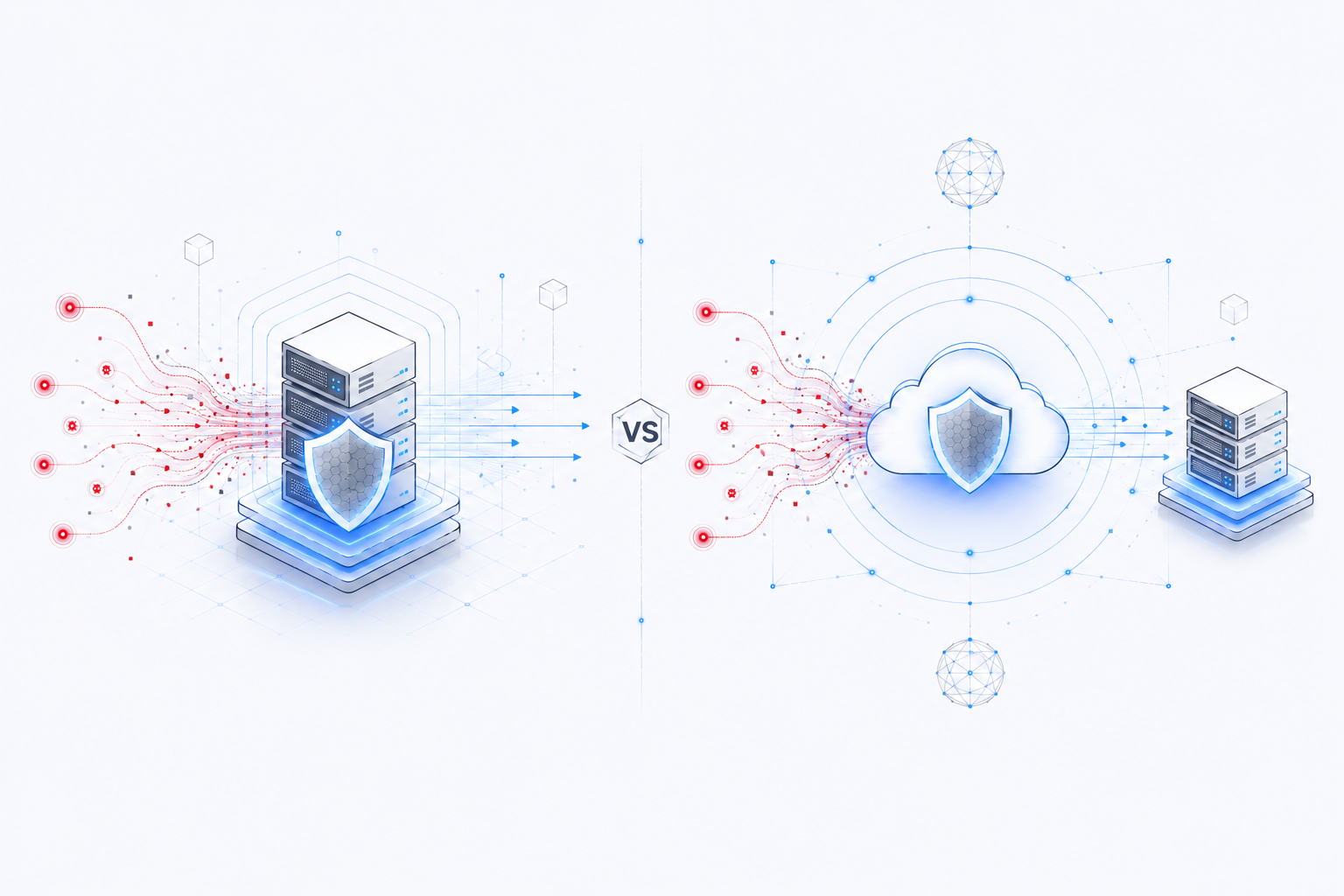




A DDoS protection server bundles hardware, connectivity, and volumetric filtering into a single hosted solution, while a remote DDoS protection service sits upstream of your existing infrastructure as a scrubbing layer.
For most businesses facing unpredictable attack volumes, the right choice depends on traffic patterns, existing server commitments, budget flexibility, and how much operational control your team can realistically manage. Neither option is universally superior. If you are evaluating remote DDoS protection services for the first time, understanding what each model actually protects, and where each one fails under real attack conditions, is the decision that matters most.
What Separates a DDoS Protection Server from a Remote Mitigation Layer
The difference is not just technical packaging. It reflects two fundamentally different philosophies about where protection should live in your infrastructure stack.
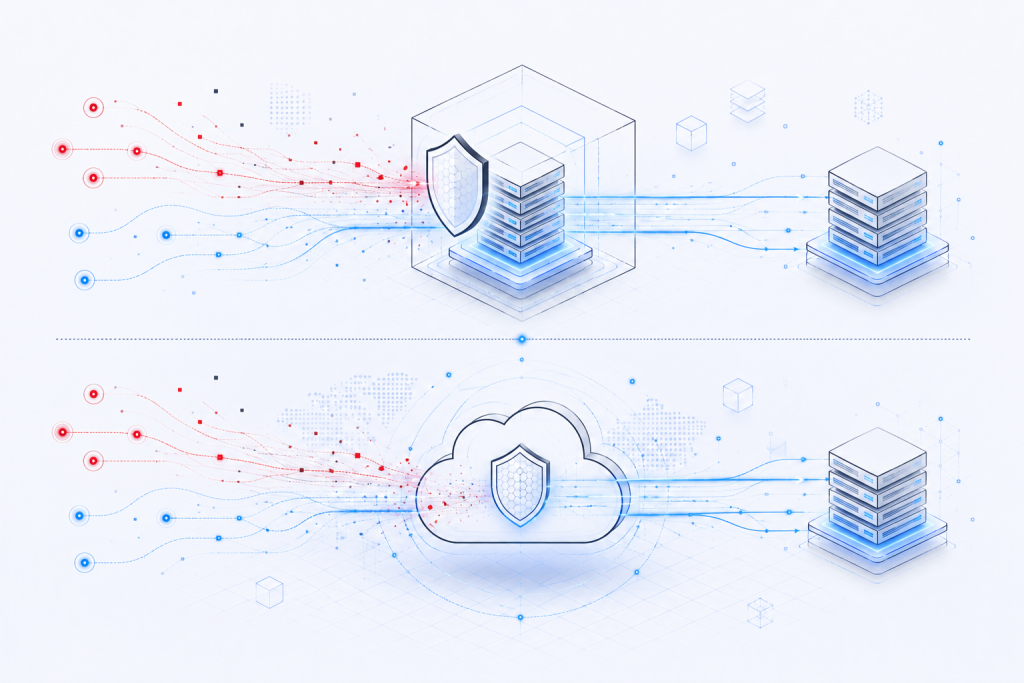
A DDoS protection server is a physical or virtual machine hosted inside a data center with upstream DDoS filtering built directly into its network. Filtering happens at the carrier edge before traffic ever reaches your server’s network interface. A remote DDoS protection service works differently. It reroutes your traffic through an external scrubbing center using BGP routing or DNS-based redirection, cleans it, and forwards legitimate traffic back to your origin server without requiring you to migrate infrastructure.
Here is where the practical difference becomes a real decision:
- Filtering location: On a DDoS protection server, attack traffic is dropped before it reaches your hardware. With remote scrubbing, traffic travels to a third-party network for cleaning first.
- Latency impact: Remote scrubbing typically adds 5 to 20 milliseconds depending on scrubbing center geography. For gaming servers, trading platforms, or real-time APIs, this matters operationally.
- Operational complexity: A DDoS protected server consolidates hosting and protection into one product. Remote services add a vendor relationship and configuration dependency.
- Flexibility: Remote DDoS protection works across multiple origin IPs without server migration, which suits agencies and resellers managing diverse infrastructure.
For latency-sensitive workloads, a DDoS protected server inside a properly filtered network is architecturally simpler and more reliable under sustained attack. For businesses with existing server commitments, remote protection adds a mitigation layer without a migration cost.
Buyers searching for a ddos protected server often want a single product that handles both hosting and protection without assembling services from multiple vendors. The appeal is operational simplicity, but it requires that your hosting provider’s network genuinely absorbs large-scale attacks at the upstream level.
Explore the comparison of remote ddos protection vs on premises to understand where each model fits depending on your existing infrastructure commitments.
Block Attacks Instantly
DDoS Protection
How DDoS Filtering Architecture Works at the Network Level
Understanding the filtering layer prevents expensive mismatches between what a provider markets and what their infrastructure can actually deliver.
DDoS protection at the server level typically relies on anycast network architecture, upstream BGP filtering, or inline scrubbing appliances positioned before traffic enters the server’s network interface. The most robust implementations combine all three: anycast routing distributes traffic across multiple points of presence, upstream filters block known attack signatures, and traffic shaping manages legitimate burst traffic without triggering false positives.
When a volumetric attack begins, filtering logic examines packet headers, source IP patterns, and traffic rate to distinguish attack traffic from legitimate requests. Attack packets are rate-limited, dropped, or blackholed depending on type and severity, typically within milliseconds on well-built infrastructure.
Remote scrubbing services operate on the same principles but introduce a routing detour. Traffic redirects to the provider’s network for cleaning before returning to your origin. Effectiveness depends on the scrubbing center’s network capacity, proximity to your user base, and how quickly it classifies new attack vectors.
For European user-facing services, scrubbing center geography matters as much as server location. A france vps server OVH vs dedicated hosting comparison illustrates how European providers differ in filtering network depth and location options, both of which directly affect protection performance under real attack conditions.
Advertised protection tiers in Gbps reflect how much attack traffic the network absorbs before clean traffic is impacted. Always match expected attack volumes to provider capacity with margin, not to the minimum advertised figure.
Real-World Use Cases Where the Choice Between These Models Becomes Clear
Different workloads expose different failure modes in DDoS protection models. The right choice depends on how your application behaves under traffic stress, not just on which option costs less.
Gaming servers face some of the highest DDoS exposure of any hosting segment. Short-duration, high-volume UDP floods are common, often triggered by players targeting opponents or servers. A DDoS protection server inside a filtered network handles this better than remote scrubbing because filtering is already active at the network edge when an attack begins, with no rerouting delay. Legitimate players stay connected while attack traffic is dropped upstream.
SaaS platforms with European user bases typically face Layer 7 threats including HTTP floods, SSL exhaustion, and bot-driven abuse, not just volumetric attacks. Remote DDoS protection services with application-layer inspection are better suited here because they analyze request behavior and block sophisticated attacks that volumetric-only filtering cannot detect at the network level.
Fintech businesses and payment processors carry a different risk calculation entirely:
- Scrubbing latency may conflict with real-time transaction processing requirements
- Downtime during financial operations carries regulatory and reputational consequences
- A dedicated server inside a low-latency filtered European data center typically performs more reliably than routing transactions through a remote scrubbing layer
Hosting resellers and agencies managing multiple client websites often benefit from remote protection because a single upstream service can cover multiple origin servers without migrating each one. Explore remote ddos protection solutions for architecture models that work across multiple origin IPs under a single mitigation layer.
eCommerce platforms during peak sales periods face both legitimate traffic surges and targeted DDoS events simultaneously. A hybrid approach, using a filtered origin server with a CDN or scrubbing layer in front, typically provides the most resilient architecture for high-traffic seasonal scenarios where neither performance nor availability can be sacrificed.
How to Implement the Right DDoS Protection Model for Your Infrastructure
Choosing the right protection model is only half the decision. Deployment and configuration determine whether it holds under real attack conditions.
For businesses choosing a DDoS protection server, start with server location. European data centers in France, Germany, the Netherlands, and the UK offer strong network interconnects and proximity to European users. Consider preventing ddos attacks on european dedicated servers as a baseline reference for hardening server-level settings alongside upstream filtering.
Bandwidth is frequently underestimated. Undersized uplinks cause legitimate traffic to queue or drop even when filtering is active. Unmetered bandwidth plans with clear burst policies perform more predictably during attack events than metered plans with overage penalties.
For remote DDoS protection deployments, the core step is updating DNS or BGP routing to direct traffic through the scrubbing provider. DNS redirection is simpler but introduces propagation delays. BGP redirection is faster and more reliable for always-on protection but requires provider BGP session support.
Monitoring matters in either model. Mitigated attacks can still affect database connections and API performance in ways network metrics alone will not show. Application performance monitoring alongside traffic analysis gives a complete picture of what your infrastructure experienced during an attack.
How the Choice Between These Models Affects Business Continuity and Cost
Infrastructure protection decisions are ultimately business continuity decisions. The cost of getting it wrong is rarely limited to the hosting invoice.
A DDoS attack that takes a SaaS platform offline for two hours during business hours costs more than the monthly hosting budget in lost revenue and customer churn risk. The price difference between a standard VPS and a properly filtered DDoS protected server quickly becomes a straightforward cost-benefit calculation when evaluated against that exposure.
Remote DDoS protection services operate on a subscription model, offering lower upfront cost and flexibility to add or remove origin IPs as infrastructure changes. The trade-off is that ongoing subscription costs add to total infrastructure spend without consolidating it.

A DDoS protection server that bundles filtering into the hosting product simplifies billing and reduces vendor relationships, which lowers operational risk for teams without dedicated security staff. Explore the available DDoS protection services to match capabilities to your actual risk exposure.
Industry guidance from infrastructure security organizations including CISA, consistently recommends aligning protection capacity to realistic attack scenarios rather than minimum viable configurations. Underspecifying DDoS protection to reduce hosting costs is a documented pattern in post-incident analysis, particularly among businesses that assumed they were too small to be targeted.
Mistakes That Undermine DDoS Protection Regardless of Which Model You Choose
Good infrastructure decisions can be undone by predictable configuration and planning errors. These mistakes appear consistently across businesses that experience repeated downtime despite having DDoS protection in place.
Choosing protection based on marketed Gbps alone is the most common error. Some providers advertise large mitigation capacities that only apply to specific attack vectors. A provider offering 1 Tbps of volumetric filtering may have no Layer 7 inspection capability, leaving application-layer attacks completely unaddressed.
Other mistakes that surface regularly include:
- Treating protection as a one-time configuration: Attack methodologies evolve. Mitigation rules effective eighteen months ago may not recognize newer amplification techniques or application-layer variants. Periodic review of filtering rules and traffic baselines is an ongoing operational requirement.
- Never testing failover behavior: Remote scrubbing services that have not been tested under real traffic conditions may behave unexpectedly during actual attack events, particularly around detection latency, clean traffic throughput, and origin handoff timing.
- Selecting infrastructure on price alone: Evaluating ddos protection without cloudflare alternatives can surface providers with different filtering architectures worth comparing against your actual risk requirements, rather than defaulting to the lowest-cost option.
- Leaving origin IP exposed in remote scrubbing deployments: If your real server IP is discoverable through DNS history, email headers, or application responses, attackers bypass the scrubbing layer entirely and target your origin directly. Restricting inbound traffic to only the scrubbing provider’s IP ranges is a required configuration step, not optional hardening.
- Underestimating bandwidth requirements during attack events: Undersized uplinks cause legitimate traffic to queue or drop even when filtering is technically working. Always plan for significantly more uplink capacity than your peak legitimate traffic volume when sizing infrastructure for DDoS-exposed workloads.
The pattern across these mistakes is the same: DDoS protection is treated as a product purchase rather than an operational discipline. Buying the right solution and configuring it correctly at launch only holds until the threat environment or your infrastructure changes, whichever comes first.
Block Attacks Instantly
DDoS Protection
The Infrastructure Choice That Holds Up Under Attack
The choice between a DDoS protection server and a remote DDoS protection service is not a question of which is technically superior. It is a question of which architecture fits your current infrastructure, team capability, traffic patterns, and risk tolerance. A DDoS protection server offers filtering at the network edge with no routing detour, which suits latency-sensitive, high-exposure workloads like game servers, real-time APIs, and financial platforms. A remote scrubbing service offers flexibility and multi-origin coverage, which suits businesses managing diverse infrastructure or needing protection without migrating servers.
Both models require realistic capacity planning, ongoing configuration review, and proper origin IP management to function effectively under real attack conditions.
For European businesses that need reliable, security-capable hosting without assembling protection from multiple vendors, NexonHost offers infrastructure designed with DDoS filtering, European data center locations, and bandwidth options suited to technical teams that need predictable performance under pressure. Evaluate your current risk exposure and compare what a consolidated hosted solution would cost against your current approach.
Frequently Asked Questions
Is a DDoS protection server the same as a DDoS protected dedicated server?
Not always. A DDoS protection server refers to any hosted server with upstream DDoS filtering included in the network. A DDoS protected dedicated server specifically means a physical machine with dedicated resources inside a filtered network. The key difference is whether the underlying server shares hardware with other tenants. For high-traffic or high-exposure workloads, dedicated hardware typically performs more consistently under sustained attack than shared VPS environments.
When does remote DDoS protection make more sense than switching servers?
Remote DDoS protection makes practical sense when you have existing servers with active deployments, database configurations, or software environments that are costly to migrate. If your current provider lacks upstream filtering but your infrastructure is otherwise stable, routing traffic through a remote scrubbing layer adds protection without requiring a server migration. It is also useful when you need to protect multiple origin IPs under a single service agreement.
How much bandwidth do I need when planning for DDoS attack scenarios?
Plan for at least two to three times your peak legitimate traffic volume as a buffer when selecting server uplinks for DDoS-exposed workloads. Attackers frequently combine volumetric floods with legitimate-looking traffic to mask attack patterns. Undersized uplinks cause legitimate traffic to queue or drop even when filtering is technically active. Unmetered bandwidth options with clearly defined burst behavior are preferable to metered plans with overage penalties for attack-prone infrastructure.
Does server location in Europe affect DDoS protection performance?
Yes, meaningfully. A server located close to your primary user base reduces baseline latency, which matters more when scrubbing or filtering adds even a small routing overhead. European data centers with strong internet exchange peering, such as those in Frankfurt, Amsterdam, London, or Paris, typically handle traffic routing more efficiently during both normal operations and attack events than servers located outside the region serving European users.
Can a small business or startup realistically be targeted by DDoS attacks?
Yes, and smaller businesses are frequently targeted precisely because they are less likely to have adequate protection in place. Competitors, disgruntled customers, and opportunistic attackers do not limit themselves to large enterprises. Booter services that allow anyone to rent attack capacity for low cost make DDoS attacks accessible to low-skill actors. Any internet-facing service, regardless of company size, carries DDoS exposure risk proportional to its visibility, not its revenue.
What is the main risk of leaving origin IP exposed in a remote scrubbing setup?
If an attacker discovers your real server IP, they can direct attack traffic directly at the origin, bypassing the scrubbing layer entirely. This completely defeats the protection model. Preventing this requires restricting inbound traffic to only the scrubbing provider’s IP ranges at the firewall level, auditing DNS history to remove any previous A records that expose the origin, and ensuring application-level responses do not leak the server IP through headers or error messages.
How do I evaluate whether a DDoS protection provider’s mitigation capacity is genuine?
Look for specific technical details in the provider’s documentation: which attack types are covered at which layers, what the actual upstream network capacity is in Gbps or Tbps, whether mitigation is always-on or requires manual activation, and what the SLA terms are specifically during attack events, not just for general uptime. Providers who cannot or will not answer these questions in specific terms are unlikely to perform reliably when you need them.