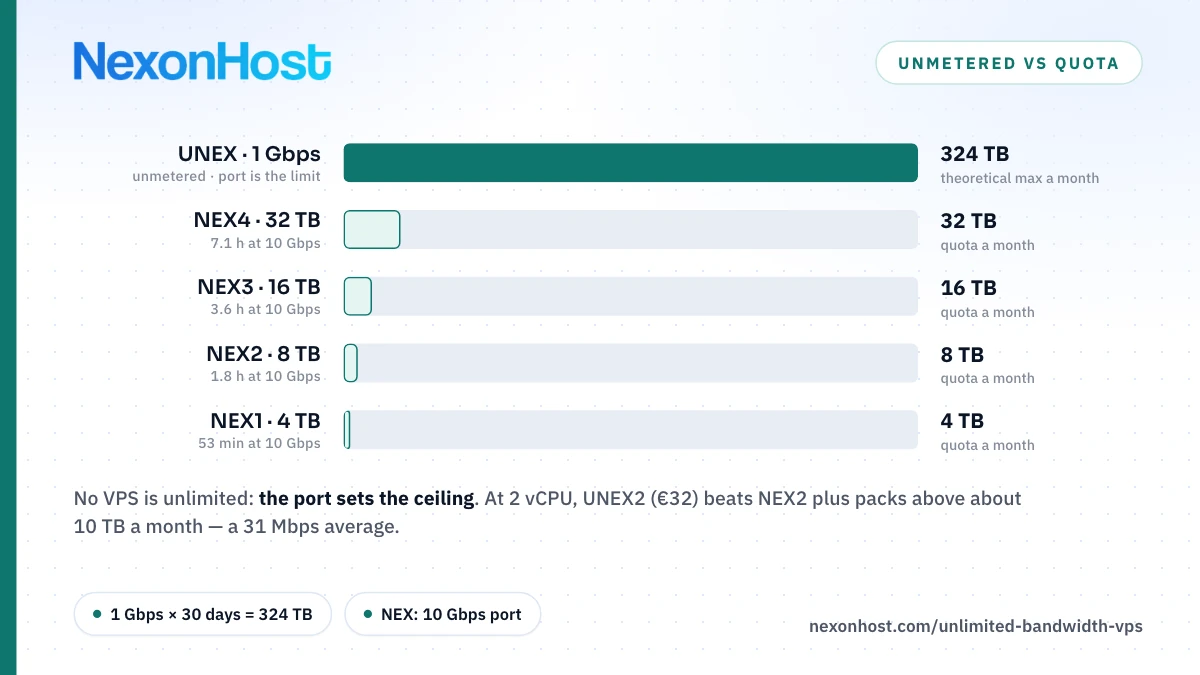
Search for an unlimited bandwidth VPS and plenty of offers use the word. None is literally true: every virtual server sits behind a network port with a speed, and a speed multiplied by the seconds in a month is a finite number of terabytes. The useful question is not "is it unlimited?" but "what is the real ceiling, and what happens as I approach it?" Below: the arithmetic, the four ways "unlimited" offers usually work, and the questions to ask any provider.
Why no VPS has unlimited bandwidth
Bandwidth is a rate: bits per second. Transfer is a volume: bytes moved over a month. A plan can drop the limit on volume, but not on rate: the port, the host's uplink and the network behind it all have a fixed capacity.
So an honest listing is either metered (a monthly TB quota) or unmetered (no quota; the port speed is the limit). NexonHost sells both, and neither is "unlimited": NEX plans have a TB quota on a 10 Gbps port, UNEX plans are unmetered on a 1 Gbps port. Unmetered vs metered hosting covers the general trade-off; this post is about the word "unlimited" and what sits behind it.
The real ceiling: port speed × time
The SI prefixes are decimal: giga is 10⁹ and tera is 10¹². A 1 Gbps port therefore carries 10⁹ ÷ 8 = 125,000,000 bytes a second. A 30-day month has 30 × 86,400 = 2,592,000 seconds:
125,000,000 × 2,592,000 = 324,000,000,000,000 bytes = 324 TB.
That is the theoretical maximum of a UNEX plan's 1 Gbps port running flat out all month in one direction; TCP overhead takes a little off, as unmetered VPS in the Netherlands works out. It is 81 times NEX1's 4 TB quota (324 ÷ 4).
A TB quota on a 10 Gbps port
NEX plans turn the shape around: a fast port and a fixed monthly volume. The store labels the TB figure "Bandwidth", but it is monthly transfer. At line rate, 10 Gbps moves 1.25 GB a second, so each quota lasts hours, not days:
| Plan, a month | Quota | Hours at 10 Gbps | Monthly average |
|---|---|---|---|
| NEX1, €9 | 4 TB | 0.9 (53 min) | 12.3 Mbps |
| NEX2, €18 | 8 TB | 1.8 | 24.7 Mbps |
| NEX3, €32 | 16 TB | 3.6 | 49.4 Mbps |
| NEX4, €64 | 32 TB | 7.1 | 98.8 Mbps |
For NEX4: 32 × 10¹² bytes × 8 = 2.56 × 10¹⁴ bits, ÷ 10¹⁰ bits a second = 25,600 seconds, or 7.1 hours. Over the month, 32 TB is 2.56 × 10¹⁴ ÷ 2,592,000 = 98.8 Mbps on average.
That is not a flaw. A 10 Gbps port pays off for bursts: a 10 GB file reaches one fast client in 10 × 8 = 80 seconds on 1 Gbps, and 8 seconds on 10 Gbps. A quota plan suits short peaks on a modest monthly total; an unmetered plan suits steady volume.
Traffic packs or unmetered: the break-even
NEX plans can take one extra-traffic pack per VPS: +2 TB for €5, +10 TB for €15 or +100 TB for €100 a month. The Netherlands guide works out the break-even for all four sizes; one example shows the shape. At 2 vCPU / 4 GB / 60 GB SSD, NEX2 plus the 2 TB pack is €23 for 10 TB, the next step (the 10 TB pack) is €33 for 18 TB, and UNEX2 is €32 with no quota.
So the line falls just above 10 TB a month, an average of 10 × 10¹² × 8 ÷ 2,592,000 = 30.9 Mbps. If your graphs show a sustained average above about 31 Mbps, the unmetered plan is the cheaper one at this size.
How "unlimited" offers usually work
When a provider advertises unlimited transfer, one of four mechanisms usually sits in the contract or the network. Each changes what you are buying.
Fair-use clauses. The acceptable-use policy reserves the right to act against "excessive" use without defining it. Ask for the number.
Throttling after a threshold. Transfer is free up to a stated volume, then the port is cut to a lower speed for the rest of the month. In effect it is still a quota, enforced by speed rather than by a bill: if a plan drops to 100 Mbps after, say, 10 TB, its real ceiling is 10 TB at full speed plus whatever 100 Mbps moves in the remaining days.
Shared uplinks. The plan says "1 Gbps", but that may be the virtual interface, not your share of the host's uplink. Picture 40 VPS on one host, each sold a 1 Gbps port, behind a single 10 Gbps uplink: 40 Gbps of promised capacity on 10 Gbps of wire is a 4:1 contention ratio. Fine while neighbours are quiet, slow at peak.
95th percentile billing. It meters rate rather than volume; the next section explains it.
95th percentile billing, explained
Under 95th percentile (or "burstable") billing, the provider samples your port's traffic rate, typically every 5 minutes. At the end of the month it sorts the samples from highest to lowest, discards the top 5%, and bills on the highest remaining sample. Inbound and outbound are often measured separately and the higher of the two billed; that is the default in the open-source LibreNMS billing module.
What does that 5% buy? A 30-day month has 30 × 24 × 12 = 8,640 five-minute samples; 5% of them is 432 samples, or 432 × 5 = 2,160 minutes, which is 36 hours. Your busiest 36 hours of the month are free.
A worked example: a server's baseline is 100 Mbps, and a 2-hour backup runs at 900 Mbps.
- Weekly backup: about 4.3 × 2 = 8.6 hours at 900 Mbps a month, inside the 36 free hours. You are billed near 100 Mbps.
- Nightly backup: 30 × 2 = 60 hours at 900 Mbps, more than 36. The 95th percentile sample lands at 900 Mbps and you are billed for nine times your baseline.
It rewards rare bursts and punishes daily ones. NexonHost's VPS plans are not billed this way.
Questions to ask any provider
Get these answered in writing, from us or anyone else:
- Is the port dedicated to my VPS, or shared with other VPS on the host? NexonHost's Xeon dedicated server ports are labelled "Unmetered (Guaranteed)" in the store; the VPS ports say "Unmetered" or give a port speed, and the pages don't state the contention. Ask sales.
- What happens at X TB? Name your volume and ask what changes: a call, a throttle, a bill. On a quota plan, ask what happens if you pass the quota without a pack; the store doesn't say.
- Is inbound traffic counted? Backups and replication streams landing on the server can be large. For NEX quotas the store doesn't document it, so ask.
- Does DDoS traffic count? Whether attack traffic counts against a NEX quota, filtered or not, is not documented; ask sales. VPS DDoS protection covers what the included filter does and doesn't stop.
- Is there a fair-use clause, and does it name a number? Read the terms of service. NexonHost's terms of service, read on 2 November 2026, name no transfer figure: §7 says resource limits and usage restrictions are those in the plan description, and §9.5 allows blocking resources used in a way that "may affect the Provider's infrastructure or other users". Read the current version yourself.
- Is billing by volume or by 95th percentile? If percentile, ask the sampling interval.
When an unmetered VPS is the wrong buy
Low traffic. Below roughly 31 Mbps sustained at the 2 vCPU size, NEX2 with or without a small pack is cheaper, and you get a 10 Gbps port for bursts.
Sustained traffic near 1 Gbps. UNEX ports upgrade to 2 Gbps (+€50) or 4 Gbps (+€200 a month), but a few vCPUs may not fill even 1 Gbps of TLS or VPN traffic. For sustained high volume, unmetered dedicated servers start at €129 a month with a 1 Gbps port.
Where to start
NexonHost sells no unlimited bandwidth VPS, and nobody can. It sells a choice of ceilings. Unmetered Linux VPS plans run from UNEX1 at €18 a month (1 vCPU, 2 GB of RAM, 40 GB SSD) to UNEX4 at €89, with no transfer quota on a 1 Gbps port. Metered Linux VPS plans run from NEX1 at €9 a month with a 4 TB quota to NEX4 at €64 with 32 TB, all on a 10 Gbps port. Every plan includes 100 Gbps of Layer 4 DDoS protection. Annual billing takes 10% off. Compare a month of your traffic graphs with the break-even above, and start on a one-month term.
Prices are as of 2 November 2026, in EUR excluding VAT, without the €5-a-month 1 TB backup add-on the store preselects; check the product page for current figures.
Sources
- BIPM — SI prefixes (giga = 10⁹, tera = 10¹²), retrieved 2 November 2026
- Wikipedia — Burstable billing: five-minute sampling, top 5% of samples ignored, under 36 hours of free burst a month, retrieved 2 November 2026
- LibreNMS documentation — Billing module: 5-minute billing poll; 95th percentile uses the higher of input and output by default, retrieved 2 November 2026
- NexonHost — Unmetered Linux VPS plans and prices, retrieved 2 November 2026
- NexonHost — Linux VPS plans, TB quotas and traffic packs, retrieved 2 November 2026
- NexonHost — Terms of service, §7 and §9.5, retrieved 2 November 2026