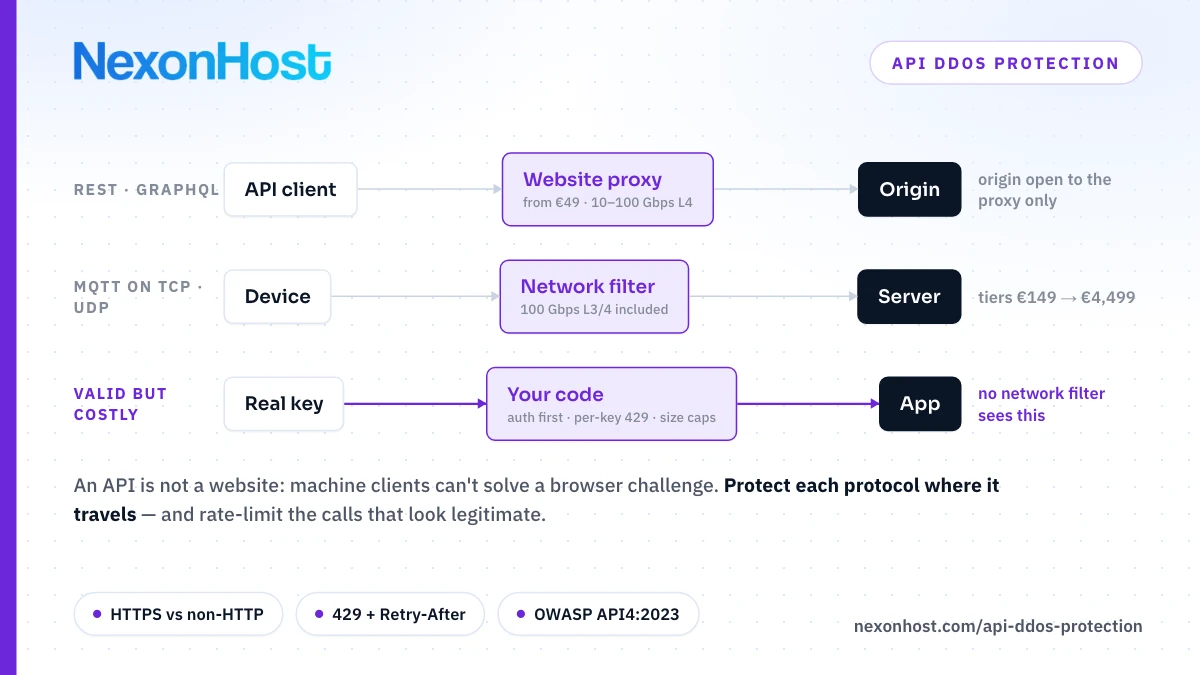
An API is not a website, and API DDoS protection fails when it is bought as if it were one. The clients are programs, part of the traffic may not be HTTP, and the costliest requests are often valid ones. A question that reaches us from search: should a fintech API platform protect its non-HTTP services with a CDN-style proxy or network-layer mitigation? This guide splits an API by protocol, says what protects each part and what it costs at NexonHost, and lists the limits only your code can set.
Your clients cannot pass a browser test
API clients are mobile apps, partner back ends, SDKs, scheduled jobs and devices. The usual Layer 7 tool against bots, the web challenge, is a browser test: a page that runs JavaScript or asks a person to solve a puzzle. A typical API client can do neither. It expects JSON, gets an HTML challenge, and the call fails. In front of a payments API, a challenge is an outage you caused yourself.
OWASP's API Security Top 10 2023 lists CAPTCHA-style human detection among the defences for API6:2023, Unrestricted Access to Sensitive Business Flows, and separately says to secure and limit access to APIs consumed directly by machines, such as developer and B2B APIs.
NexonHost's website proxy lists a web challenge (robot detection) on every plan. Its product pages do not say whether the challenge can be switched off or scoped per hostname or path, so ask before you put an API behind it. Either way, give the API its own hostname, such as api.example.com, so its policy can differ from the website's.
Split the API by protocol
The first question in DDoS protection for APIs is not which vendor but which protocol. An HTTP(S) reverse proxy forwards HTTP; raw TCP, MQTT on its own TCP ports and custom UDP cannot pass through it. For those, non-HTTP DDoS protection means filtering at the network layer, in front of the server. So the answer to the fintech question is both: a proxy for the HTTP parts, network-layer filtering for the rest and for the origin.
| Traffic | Attack layer | What protects it | NexonHost option, a month |
|---|---|---|---|
| REST or GraphQL over HTTPS | L3/4 floods, HTTP request floods | HTTP(S) proxy; origin accepts only the proxy | Website proxy, €49 to €710 |
| The same API, no proxy | L3/4 and HTTP floods | Layer 7 filtering on the server's tier | 10 Tbps tier, €4,499 |
| gRPC, WebSocket, client-certificate TLS | L3/4 and L7 | A proxy, only if it supports them | Not documented: ask |
| Raw TCP or MQTT | Floods, SYN floods, connection exhaustion | Network-layer filtering; early auth, connection caps | 100 Gbps included; €149 to €2,499 for more |
| Custom UDP | Floods, small-packet floods | Network-layer filtering only | Same ladder; the proxy cannot carry it |
| Costly calls by valid clients | Application logic | Auth first, per-key limits, size and page caps | Your code |
Every row but the last can be bought (the third only if the proxy supports it); valid requests pass every filter.
HTTP APIs behind the website proxy
REST and GraphQL over HTTPS can sit behind NexonHost's website DDoS protection proxy, in front of an origin hosted anywhere. Every plan in the store lists a web challenge, GEO-IP blocking, WAF support, live logs and SSL, plus, from Small up, ASN blocking and advanced flood filters. Layer 4 capacity and price, a month: Micro 10 Gbps, €49 (€44.10 billed annually); Small 25 Gbps, €139; Business 50 Gbps, €399; Enterprise 100 Gbps, €710, with options up to 1 Tbps.
The Remote DDoS Protection FAQ says the service "secures websites and APIs". The same page lists rate limiting as an add-on that restricts traffic "by region or IP behavior", with nothing about API keys, and the pages do not mention gRPC, WebSocket or client-certificate (mutual TLS) authentication; if you depend on any of them, get the answer in writing.
Do not count on caching: authenticated API responses are usually specific to one client, so the origin still serves every request that gets through. A proxy only protects the address it stands in front of; if the origin's real IP leaks, attackers go around it. Hiding the origin IP covers the leaks and the firewall rule.
Non-HTTP services: the network layer is the protection
An MQTT broker on TCP (port 1883, or 8883 with TLS), a raw TCP market-data feed or a custom UDP protocol relies on the server's own protection. Every NexonHost DDoS protected dedicated server and every VPS includes 100 Gbps at Layer 3/4. The product page says it covers UDP, ICMP and amplification floods, SYN floods and connection exhaustion, dropped upstream before they reach your port, and is active from the moment the server is online (always-on vs on-demand explains why that matters).
Above that, per server, per month: 500 Gbps €149, 1 Tbps €499, 2 Tbps €999, 5 Tbps €2,499, all Layer 4. Layer 7 on the server comes only with the 10 Tbps tier, at €4,499, and the page's Layer 7 examples are HTTP floods, bot traffic and slow-request attacks; do not assume it parses MQTT.
UDP services also face small-packet floods, which exhaust packet rate before bandwidth. NexonHost publishes Gbps only, so ask what packet rate your tier handles; Gbps vs Mpps shows the arithmetic. On the server, authenticate at the start of each session, cap connections per client address and time out idle ones.
Keep non-HTTP services off the API origin's address
An MQTT broker on port 1883 or 8883 cannot sit behind an HTTP proxy (MQTT over WebSocket might, if the proxy carries WebSocket), so its DNS record publishes a real server address. If that is also your proxied API origin, anyone can look up the broker's name and flood the origin directly. Put them on a separate address (an extra IPv4 address on a NexonHost dedicated server or VPS is €3 a month) or a separate server, which also keeps a flood on one service from filling the other's port.
What no network filter does for you
OWASP's API4:2023, Unrestricted Resource Consumption, says an API is vulnerable if any of a list of limits is missing or set wrongly, and that exploitation can mean denial of service or a higher bill. Only your application knows who the client is and what a request costs.
| Limit (OWASP API4:2023) | How to set it | What the client sees |
|---|---|---|
| Requests per client per window | Per API key or account, not per IP | 429 with Retry-After |
| Payload size | A maximum per endpoint, checked first | 413 Content Too Large |
| Records per page | A hard maximum, enforced server-side | A capped page |
| Operations per request | Count GraphQL operations, not HTTP requests | A rejected query |
| Execution time, memory, processes | Timeouts and container limits | An error, not a stuck worker |
| Third-party spend (SMS, email) | A spending limit or billing alert | Nothing; it protects your bill |
Throttle the costly operation. OWASP's first API4 scenario is a password-reset call, made before any login, that makes the back end send an SMS billed at $0.05, called tens of thousands of times by a script. At 50,000 calls that is 50,000 × $0.05 = $2,500, and every request is valid HTTP. OWASP's fix: limit how often one client or user can run it.
Count operations, not requests. In the second scenario, an endpoint rate-limited per request accepts one HTTP request that batches the same picture-upload mutation hundreds of times (OWASP's example runs to pic999), and the server runs out of memory. A filter that counts requests sees one.
Count per key, not per IP. Many customers can share one address behind NAT, and OWASP's API6 scenario runs one attacker's script across many addresses. A proxy's rate limit usually counts addresses; your application sees keys.
Rate limits that clients can obey
The status code for "over your limit" is 429 Too Many Requests, from RFC 6585 §4. The RFC leaves it to the server how it counts requests and identifies the user, for example by credentials, and says a 429 must not be cached. Add Retry-After, a date or a number of seconds (RFC 9110 §10.2.3):
HTTP/1.1 429 Too Many Requests
Retry-After: 120
Content-Type: application/json
Keep 429 for one client over its limit; RFC 9110 uses 503 Service Unavailable for a server that cannot handle requests because of temporary overload.
This is DDoS defence: a client library that retries at once on every error turns a slowdown into a flood from your own customers, so make your SDKs honour Retry-After. An IETF Internet-Draft, draft-ietf-httpapi-ratelimit-headers-12 (20 November 2026), defines RateLimit-Policy and RateLimit header fields that announce quotas in advance; it is a draft, not an RFC.
A worked setup for a SaaS API
DDoS protection for SaaS is usually a mix. Take an HTTPS API and an MQTT channel for devices on one €129-a-month dedicated server (20 cores, 128 GB of RAM, unmetered 1 Gbps port):
- api.example.com behind the Small proxy (25 Gbps): €139, origin firewalled to the proxy.
- The MQTT broker on a second address: €3, covered by the included 100 Gbps.
- Total: €129 + €139 + €3 = €271 a month.
Layer 7 on the server instead means the 10 Tbps tier: €129 + €4,499 = €4,628 a month, about 17 times as much (4,628 ÷ 271). If an attack is already under way, what to do when your server is under DDoS attack is the first-hour runbook.
Where NexonHost fits
For API DDoS protection at NexonHost: the website DDoS protection proxy for HTTP(S) APIs from €49 a month, and for everything that is not HTTP, a DDoS protected dedicated server from €129 a month or a VPS from €9 a month in Germany, the Netherlands or Romania, both with 100 Gbps of Layer 3/4 protection included.
None of them knows your API keys or what a call costs; per-client limits are your code's job. Before you buy, ask sales about the web challenge on API hostnames, gRPC, WebSocket, client certificates and your tier's packet rate. Start on a one-month term and test with your real clients.
Prices as of 23 November 2026, in euros excluding VAT; check the product pages before you order.
Sources
- OWASP API Security Top 10 2023 — the list of ten API risks, retrieved 23 November 2026
- OWASP API4:2023 Unrestricted Resource Consumption — limits an API needs, the $0.05 SMS scenario, the GraphQL batching scenario (pic1 to pic999), prevention list including per-operation throttling, retrieved 23 November 2026
- OWASP API6:2023 Unrestricted Access to Sensitive Business Flows — human detection (CAPTCHA), machine-consumed APIs, a script run across many IP addresses, retrieved 23 November 2026
- RFC 6585 — Additional HTTP Status Codes, §4: 429 Too Many Requests, how the user is identified and requests counted, not cacheable, retrieved 23 November 2026
- RFC 9110 — HTTP Semantics: §10.2.3 Retry-After (date or seconds), §15.5.14 413 Content Too Large, §15.6.4 503 Service Unavailable, retrieved 23 November 2026
- IETF Internet-Draft draft-ietf-httpapi-ratelimit-headers-12 — RateLimit header fields for HTTP, 20 November 2026, work in progress, retrieved 23 November 2026
- OASIS MQTT Version 5.0 — §4.2 Network Connections: TCP, TLS and WebSocket transports; TCP ports 1883 and 8883 registered with IANA, retrieved 23 November 2026
- NexonHost — DDoS protected dedicated servers, retrieved 23 November 2026: attacks covered by the included tier, filtering upstream before the port, active from first boot, tiers and prices, Layer 7 on the 10 Tbps tier only (examples: HTTP floods, bot traffic, slow-request attacks)
- NexonHost — Remote DDoS Protection, retrieved 23 November 2026: Layer 4 capacity per plan, Micro at €44.10 a month billed annually, the FAQ on websites and APIs, the "Geo-Blocking & Rate Limiting" add-on. Monthly plan prices, features (web challenge, GEO-IP blocking, WAF support, live logs, SSL; ASN blocking and advanced flood filters from Small up) and Enterprise options to 1 Tbps from the NexonHost store, retrieved 23 November 2026
- NexonHost store — dedicated server and VPS prices, VPS regions, extra IPv4 at €3 a month, DDoS tier ladder, retrieved 23 November 2026
- Computed — 50,000 × $0.05 = $2,500; €129 + €139 + €3 = €271; €129 + €4,499 = €4,628; 4,628 ÷ 271 ≈ 17.1