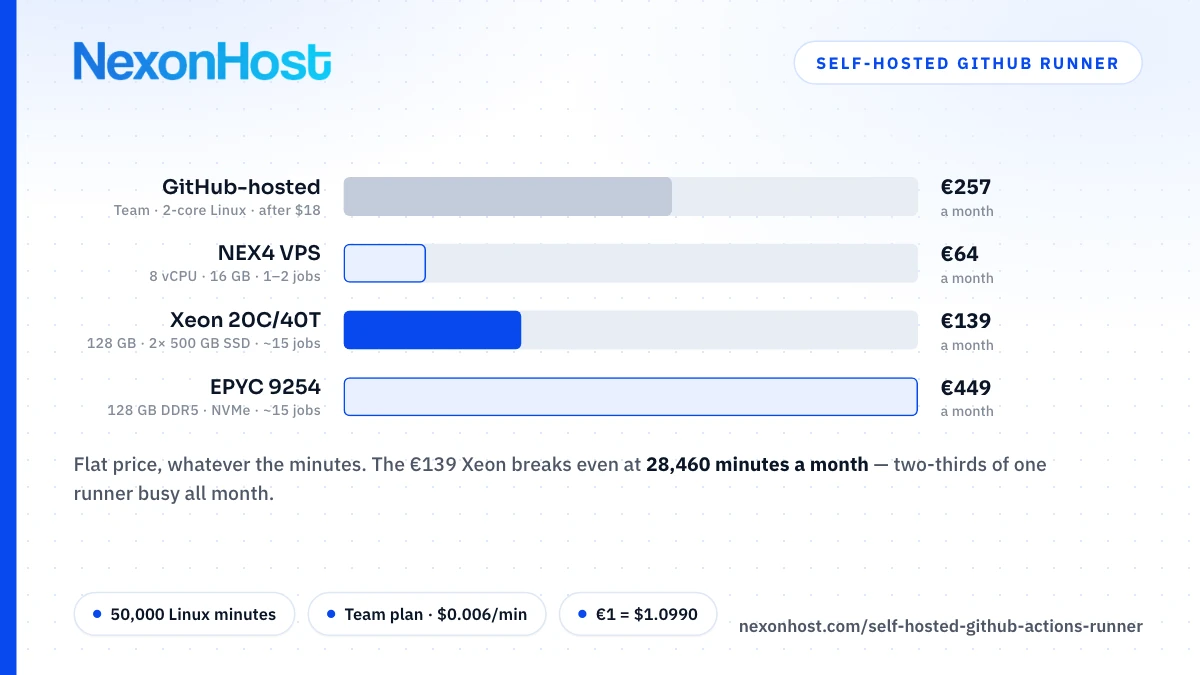
A self-hosted GitHub Actions runner is GitHub's open-source runner application on a machine you control: GitHub schedules the jobs, your server runs them. In November 2026 GitHub charges nothing for those minutes, while its standard 2-core hosted Linux minutes cost $0.006 each. Below: GitHub's 2026 pricing, the break-even against a dedicated server, sizing and GitHub's security rules.
What GitHub charges in November 2026
GitHub-hosted runners. On 1 January 2026 GitHub cut hosted-runner prices "by up to 39%". Its pricing reference lists the standard Linux 2-core x64 runner at $0.006 a minute, the rate used below (1-core Linux is $0.002, 2-core arm64 $0.005); in a private repository that machine has 2 CPUs, 8 GB of RAM and a 14 GB SSD. Each job is rounded up to the whole minute, so a 20-second lint job bills as one.
Each plan includes monthly compute, expressed in dollars: $12 on Free, $18 on Pro and Team, $300 on Enterprise Cloud. At $0.006 that is 12 ÷ 0.006 = 2,000, 18 ÷ 0.006 = 3,000 and 300 ÷ 0.006 = 50,000 Linux minutes.
Self-hosted runners. On 16 December 2025 GitHub announced a $0.002-per-minute "cloud platform charge" on self-hosted runner usage from 1 March 2026. An update at the top of the same changelog post (last modified 17 December 2025) says GitHub is "postponing the announced billing change for self-hosted GitHub Actions" to re-evaluate its approach. GitHub's public roadmap item for the charge was closed as not planned on 19 December 2025.
As of 23 November 2026 we found no later GitHub post setting a new date, and GitHub's billing documentation lists self-hosted runners as usage that "remains free" and does not reduce included compute. The charge is not in force and is left out below.
When to stay on GitHub-hosted runners
Skip the server in three cases:
- Public repositories. Hosted runners are free there, and GitHub recommends self-hosted runners only for private repositories, because a pull request from a fork can run code on your machine.
- Low volume. Inside the allowance, 3,000 minutes a month on Team, you pay GitHub nothing for minutes.
- Nobody will patch it. A hosted runner is a clean virtual machine per job. A self-hosted one can be "persistently compromised" by untrusted workflow code, GitHub's docs say, and its operating system is yours to update.
The break-even arithmetic
Set a flat server price against the same minutes on hosted runners on a Team plan: minutes × $0.006 − $18. Euros convert at the ECB reference rate for 20 November 2026, €1 = $1.0990.
- 2× Xeon E5-2630 v4 (20 cores / 40 threads, 128 GB): €129 plus €10 for 2× 500 GB SSD (see sizing), €139 = $152.76. Break-even: (152.76 + 18) ÷ 0.006 = 28,460 minutes a month.
- AMD EPYC 9254 (24 cores / 48 threads, 128 GB DDR5, 2× 1 TB NVMe): €449 = $493.45. (493.45 + 18) ÷ 0.006 ≈ 85,240 minutes.
- NEX4 Linux VPS (8 vCPU, 16 GB): €64 = $70.34. (70.34 + 18) ÷ 0.006 ≈ 14,720 minutes.
One runner busy around the clock for 30 days delivers 30 × 24 × 60 = 43,200 minutes. The Xeon pays for itself with the work of one runner busy two-thirds of the month (28,460 ÷ 43,200 = 0.66); the rest of the box is spare capacity. The EPYC needs nearly two runners busy all month (85,240 ÷ 43,200 = 1.97).
Two caveats. This assumes a job takes as long on your server as on GitHub's 2-CPU machine; we have not measured that. And had the postponed charge applied as announced, $0.002 a self-hosted minute drawn first from the same $18, the Xeon's break-even would be 152.76 ÷ (0.006 − 0.002) = 38,190 minutes.
Four options at 50,000 minutes a month
Private-repository Linux jobs on a Team plan; prices a month, excluding VAT, as of 23 November 2026:
| Option | Cost a month | Jobs at once | Caveats |
|---|---|---|---|
| GitHub-hosted, Linux 2-core | 50,000 × $0.006 − $18 = $282 (≈ €257) | 60 on Team | Clean VM per job; nothing to patch; 6 h job limit |
| NEX4 Linux VPS | €64 | 1–2 | 100 GB SSD; two runners 58% busy all month; bursts queue |
| 2× Xeon E5-2630 v4 + 2× 500 GB SSD | €139 | about 15 | SATA SSD; you patch it; provisioned in minutes |
| EPYC 9254 | €449 | about 15 | NVMe RAID 1; about 2 weeks to deliver; dearer than hosted below 85,240 minutes |
On Enterprise Cloud the $300 allowance covers exactly those 50,000 minutes.
How many runners fit on one server
The runner application "only requires minimal resources", GitHub says; your jobs set the size, and Docker-based actions need Linux with Docker.
Start from GitHub's private-repository machine, 2 CPUs and 8 GB per job, and hold 8 GB back for the host (our assumption). The Xeon fits (128 − 8) ÷ 8 = 15 runners, using 15 × 2 = 30 of 40 threads; the EPYC fits the same 15 at three threads each, 45 of 48, because memory sets the count. A NEX4 holds one 8 GB runner, or, leaving the host 2 GB, (16 − 2) ÷ 7 = 2 at 7 GB.
Disk runs out first. Fifteen workspaces of GitHub's 14 GB are 15 × 14 = 210 GB, leaving 30 GB of the Xeon's default 240 GB SSD for the OS and Docker images, so take the 2× 500 GB option. The Xeon builds ship SATA SSDs; NVMe is on the EPYC builds. Our Xeon vs EPYC guide compares clocks, memory bandwidth and I/O, and our guide to benchmarking a dedicated server shows how to measure yours; we publish no CI speed figures.
If you already run Kubernetes, GitHub recommends Actions Runner Controller (ARC), which starts ephemeral runner pods registered with just-in-time tokens; our guide to Kubernetes on bare metal covers the cluster underneath.
Docker images and the Docker Hub limit
GitHub's limits page says self-hosted runners pulling from Docker Hub are "always subject to the rate limit"; hosted runners pulling public images are not. Docker's table gives unauthenticated users 100 pulls per 6 hours per IPv4 address or IPv6 /64, and authenticated Personal accounts 200. Every runner on a server shares its address, so that 100 is for the whole box.
Two ways out: authenticate the pulls, or run Docker's registry as a pull-through cache, which fetches an image once and serves later pulls from its own storage. Keep it outside any job's workspace so it survives ephemeral runners being wiped.
Running it safely: GitHub's own rules
GitHub says self-hosted runners should "almost never be used for public repositories". Even on private ones, anyone who can fork and open a pull request, generally anyone with read access, can compromise the runner, its secrets and the GITHUB_TOKEN.
What the docs recommend:
- Ephemeral or just-in-time runners. Register with
--ephemeral, or create JIT runners through the REST API: each runs at most one job, then is removed. Give every job a clean container or VM too; GitHub warns that re-used hardware can expose information. - Runner groups. Organisation runners take jobs from many repositories, so a compromise spreads. Every organisation has a default group; Team-plan owners can create more and limit which repositories reach each.
- Nothing valuable on the box. No private SSH keys or API tokens, and no network path to sensitive services.
- Current runner software. Auto-update is on by default. Turn it off and you must install each release within 30 days (GitHub's June 2026 changelog; its reference page still says 63) or jobs stop.
Network: outbound HTTPS only
The runner connects out to GitHub; its requirements are outbound HTTPS on port 443 to github.com, api.github.com and *.actions.githubusercontent.com, plus listed domains for artifacts, caches and updates, and at least 70 kilobits per second each way. The docs list no inbound port, so deny all inbound traffic except SSH from your own addresses. Our new server security checklist covers the rest of day one.
Which server to start with
Past roughly 28,500 private-repository Linux minutes a month, a self-hosted GitHub Actions runner fleet on the 2× Xeon E5-2630 v4 dedicated server costs less than hosted minutes and runs about 15 jobs at once: €129 a month, €139 with 2× 500 GB SSD, provisioned automatically in minutes in any of our 12 cities. Take the EPYC 9254 (€449 a month, about two weeks to deliver) only once you have measured that disk or single-thread speed limits your jobs. For one or two runners beside a deploy target, a NEX4 Linux VPS at €64 a month in Germany, the Netherlands or Romania will do. Every plan includes 100 Gbps Layer 4 DDoS protection.
Prices as of 23 November 2026, EUR excluding VAT; the store preselects a 1 TB backup add-on at €5 a month extra, so check the product page. Start on a one-month term and time your real workflows before committing.
Sources
- GitHub Changelog — Update to GitHub Actions pricing: $0.002-per-minute self-hosted charge announced 16 December 2025 for 1 March 2026; update (modified 17 December 2025) postponing it; hosted-runner cut of up to 39% on 1 January 2026, retrieved 23 November 2026
- GitHub Changelog — Reduced pricing for GitHub-hosted runners usage, in effect 1 January 2026, retrieved 23 November 2026
- GitHub Executive Insights — Pricing changes for GitHub Actions: postponement notice above the original announcement; public-repository usage stays free, retrieved 23 November 2026
- GitHub public roadmap — issue 1197, self-hosted runner price increase, closed as not planned 19 December 2025, retrieved 23 November 2026
- GitHub Docs — Actions runner pricing: Linux 2-core x64 $0.006, Linux 1-core $0.002, Linux 2-core arm64 $0.005 a minute; jobs rounded up to the whole minute, retrieved 23 November 2026
- GitHub Docs — GitHub Actions billing: included compute $12 / $18 / $18 / $300; self-hosted runners and public-repository standard runners remain free, retrieved 23 November 2026
- GitHub Docs — Choosing the runner for a job: private-repository ubuntu-latest has 2 CPUs, 8 GB RAM, 14 GB SSD, retrieved 23 November 2026
- GitHub Docs — Actions limits: 60 concurrent jobs on Team; 6-hour hosted job limit; Docker Hub rate limit for self-hosted runners, retrieved 23 November 2026
- GitHub Docs — Self-hosted runners: free to use; you update the OS and all other software, retrieved 23 November 2026
- GitHub Docs — Self-hosted runners reference: machine requirements, ARC recommendation, --ephemeral, 63-day update rule, outbound HTTPS on 443, 70 kbit/s, domain list, retrieved 23 November 2026
- GitHub Changelog — Minimum version enforcement timeline for self-hosted runners (12 June 2026): each new runner release must be installed within 30 days or GitHub stops queuing jobs to the runner, retrieved 23 November 2026
- GitHub Docs — Secure use reference: hardening for self-hosted runners, public repositories, forks, JIT runners, runner groups, retrieved 23 November 2026
- GitHub Docs — Managing access to self-hosted runners using groups: private repositories only; default group; Team plan groups, retrieved 23 November 2026
- GitHub Docs — Actions Runner Controller: ephemeral runner pods with just-in-time configuration tokens, retrieved 23 November 2026
- Docker Docs — Docker Hub usage and limits: 100 pulls per 6 hours unauthenticated per IPv4 or IPv6 /64, 200 for Personal, retrieved 23 November 2026
- Docker Docs — Mirror the Docker Hub library: registry as a pull-through cache, retrieved 23 November 2026
- European Central Bank — euro reference rate for the US dollar: €1 = $1.0990 on 20 November 2026, retrieved 23 November 2026
- NexonHost store — 2× Xeon E5-2630 v4 (€129, 2× 500 GB SSD +€10), EPYC 9254 (€449, about 2 weeks), NEX4 Linux VPS (€64), VPS regions, 1 TB backup add-on €5, DDoS tiers, retrieved 23 November 2026
- Computed — €1 = $1.0990: €139 = $152.76, €449 = $493.45, €64 = $70.34; break-even (152.76 + 18) ÷ 0.006 = 28,460; (493.45 + 18) ÷ 0.006 = 85,241.7 ≈ 85,240; (70.34 + 18) ÷ 0.006 = 14,723.3 ≈ 14,720; 12 ÷ 0.006 = 2,000; 18 ÷ 0.006 = 3,000; 300 ÷ 0.006 = 50,000; 50,000 × 0.006 − 18 = $282 ÷ 1.0990 ≈ €257; 30 × 24 × 60 = 43,200; 28,460 ÷ 43,200 = 0.66; 85,240 ÷ 43,200 = 1.97; 152.76 ÷ 0.004 = 38,190; (128 − 8) ÷ 8 = 15; 15 × 2 = 30; 15 × 3 = 45; (16 − 2) ÷ 7 = 2; 50,000 ÷ (2 × 43,200) = 0.58; 15 × 14 = 210 GB; 240 − 210 = 30 GB