Does Hetzner have DDoS protection? Yes. Hetzner's own DDoS page says it is automatic, available to all customers and free of charge. The page does not publish a capacity figure, anything about HTTP (Layer 7) floods, or what happens to an address when an attack outgrows the filters. Below: what Hetzner DDoS protection covers according to Hetzner's own pages, retrieved 23 November 2026, when that is enough, and when a published capacity ladder is worth paying for.
Disclosure: NexonHost sells DDoS-protected servers, so we are a competitor. Each Hetzner claim is cited to Hetzner's own pages in the sources; where they are silent, we say so.
Does Hetzner have DDoS protection?
Yes, at no extra cost. Hetzner's DDoS protection page says it uses automated tools to protect "web applications, websites, servers, and IT infrastructure", and that the protection "has not caused costs or prices to increase and is available to all customers".
The docs back that up. Hetzner's technical and organisational measures page ticks "Continuously active DDoS recognition" for colocation, dedicated servers, cloud servers, Storage Boxes and Object Storage, and for its managed servers, web hosting and Storage Shares. Its cloud locations FAQ asks whether the DDoS system in Ashburn is the same as in Hetzner's other data centres, and answers "Yes".
The same docs list Hetzner's own data-centre parks in Nuremberg, Falkenstein and Helsinki; Ashburn, Hillsboro and Singapore are currently cloud-only, in colocation space.
How Hetzner says the filtering works
The DDoS page describes three stages, on hardware from vendors it names, including Arbor and Juniper:
- Recognition by attack type, not only size. Besides the amount of traffic and the number of packets, detection pins down the actual attack type and reacts to it. The page's own example: a UDP flood at 500k packets per second is harmless for a server, while 500k SYN packets "could pose a problem".
- Scrubbing filters for known patterns, which the page says work especially well against DNS reflection, NTP reflection and UDP floods on port 80.
- Challenge-response authentication and dynamic filtering, the final stage, against SYN floods, DNS floods and invalid packets.
Once an attack is recognised, the English page says the tools "immediately go into action" (the German version says within a few seconds), and that your traffic is usually not affected. The measures page adds that malicious traffic "is automatically filtered before it reaches the target systems".
A vendor source adds a newer detail: Nokia's customer case study says Hetzner selected Nokia Deepfield Defender to strengthen DDoS protection across its European data centres, with mitigation performed inside Hetzner's own network rather than at external scrubbing centres, and coverage extending to its peering connections. The case study does not mention application-layer filtering.
What Hetzner does well
- It is on by default and free. Detection runs "at all times", and filtering starts automatically once an attack is recognised. The page's two diagrams show traffic going straight from router to server in normal operation, and through the filtering system during an attack; always-on vs on-demand protection explains what to ask about that model.
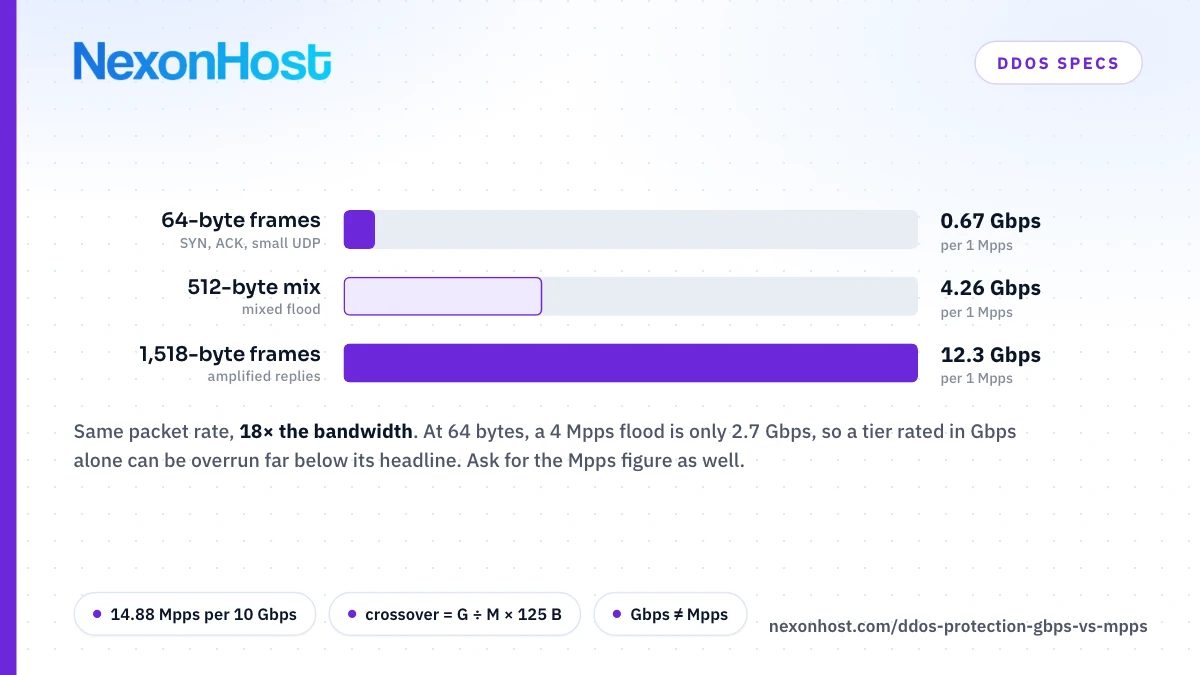
- It looks at packets, not just bits. The SYN example makes the same point as our Gbps vs Mpps guide: packet rate and packet type can matter more than volume.
- Cloud servers can get a stateful firewall. Hetzner's Cloud Firewall docs say an applied firewall drops new incoming traffic unless a rule allows it.
- It does not overclaim. The page says the system thwarts "the vast majority" of attacks, not all of them.
What Hetzner's DDoS pages do not say
A gap on a page is not a gap in the network, so treat these as questions, not criticisms:
- Capacity. Neither the DDoS page nor the docs cited below publish a capacity figure for the filtering, in Gbps or in packets per second. The 500k figure above is an example of how detection reasons, not a limit.
- Layer 7. The page names reflection, UDP, SYN and DNS floods and invalid packets. It does not mention HTTP floods, so ask Hetzner whether and how application-layer attacks on a website are handled.
- Above capacity. The DDoS page and the docs cited below do not say what happens to an IP address when an attack is larger than the filters can absorb: whether filtering continues, the address is taken off the network for a time, or something else.
- An upgrade. The DDoS page lists no paid tier or larger option, and neither do the docs cited below.
Hetzner's own advice is to ask. Its cloud FAQ says: "If you have detailed questions about our DDoS system please write a support request". Do that before you depend on it, and keep the answers.
Five questions to ask any host
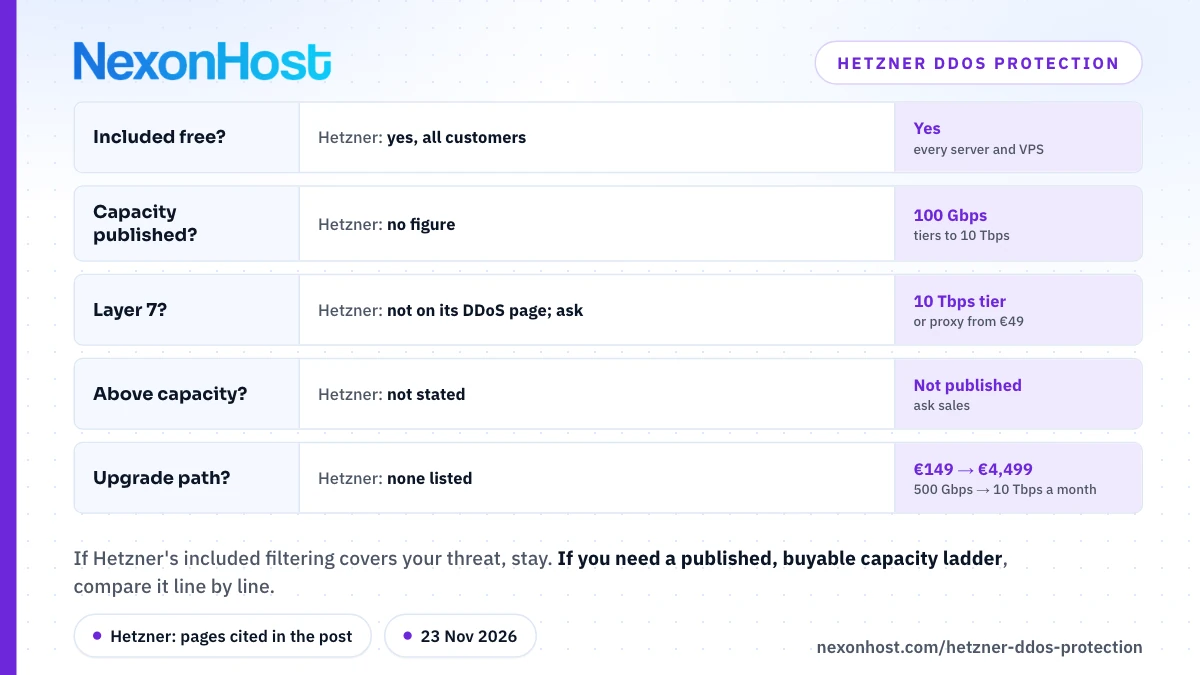
| Question | Hetzner (pages cited below) | NexonHost |
|---|---|---|
| Included at no extra cost? | Yes, all customers | Yes, every dedicated server and VPS |
| Capacity published? | No figure | 100 Gbps included; tiers to 10 Tbps (Gbps only) |
| Layer 7 (HTTP)? | Not on its DDoS page; ask | 10 Tbps tier, or website proxy from €49 |
| What happens above capacity? | Not stated | Not published; ask sales |
| Paid upgrade path? | None listed | 500 Gbps €149 up to 10 Tbps €4,499 a month |
Neither Hetzner's pages cited here nor ours say what happens above capacity, and NexonHost publishes no packet-rate figure for any tier. Ask us, Hetzner and everyone else on your shortlist.
When included filtering is enough
- Most websites and APIs. Most attacks are small: Cloudflare's report for the first half of 2026 found that 96.62% of the network-layer attacks it mitigated stayed under 500 Mbps. For HTTP floods, put a proxy or CDN in front of the site, because a network filter sees valid-looking requests.
- A service with no attack history. Start on the included protection, record what normal traffic looks like, and pay for more only when you have evidence.
If that is you, and Hetzner's support answers the open questions in a way that fits your risk, there is no reason to move hosts for DDoS protection alone.
When it may not be enough
- Sustained large attacks. If an address already draws big floods, you need the capacity and the above-capacity policy before the next attack, not during it.
- UDP game and VoIP services. They need filtering tuned to the protocol, and a web proxy cannot carry them; game server DDoS protection explains why.
- A capacity number in writing. A contract or risk register may need a figure you can point to and buy more of.
- Layer 7 on the network path. If you cannot move DNS to a third-party proxy, ask whether your host offers application-layer filtering itself, and at what size.
None of these proves Hetzner cannot help; they are where its DDoS pages leave you asking.
A Hetzner DDoS alternative with a published ladder
If you need a Hetzner DDoS alternative with the numbers on the page, here is what NexonHost publishes (EUR ex VAT, as of 23 November 2026):
- Included: 100 Gbps of Layer 4 protection on every dedicated server and every VPS.
- Paid tiers, per server per month: 500 Gbps €149, 1 Tbps €499, 2 Tbps €999, 5 Tbps €2,499, and 10 Tbps with Layer 7 filtering €4,499. Here is the € per Gbps of each tier.
- How it is described: the DDoS protected dedicated server page says floods are "dropped upstream, before they reach your port", that "Protection is active from the moment the server is online; there is nothing to enable", and that "Clean traffic is not capped or billed while an attack is being filtered". The DDoS mitigation services page lists mitigation in Germany, the Netherlands and Romania; ask sales where your traffic is filtered.
- For websites: the website DDoS protection proxy starts at €49 a month, with a web challenge, GEO-IP blocking and WAF support. It carries HTTP(S) only, not game or VoIP UDP.
On the €129 Xeon build, adding 500 Gbps makes €129 + €149 = €278 a month; adding the €49 proxy for Layer 7 instead makes €129 + €49 = €178; the 10 Tbps tier makes €129 + €4,499 = €4,628.
Dedicated servers run in twelve cities: Amsterdam, Frankfurt, Bucharest, Vienna, Sofia, Paris, Marseille, Dublin, Milan, Warsaw, Madrid and Ashburn, with the same ladder in each. VPS run in Germany, the Netherlands and Romania.
What it does not solve: the included tier filters Layer 3 and 4 only, no tier has a published packet rate, and the above-tier policy is not published.
Stay or switch
If Hetzner DDoS protection covers the attacks you actually see, stay. It is free, automatic and covers Hetzner's servers and storage, and moving hosts costs time and risk.
If you need a published, buyable capacity ladder or a Layer 7 option you can order, compare the DDoS protected dedicated server builds and the full dedicated servers range, and start on a one-month term. Questions about filtering location or attacks above a tier go to our sales team.
Prices as of 23 November 2026, EUR ex VAT, a month; the store preselects a 1 TB backup add-on at €5 a month extra. Check the product page before you order.
Sources
- Nokia — customer case study: Hetzner strengthens DDoS protection across European data centers with Nokia Deepfield Defender, retrieved 23 November 2026: Deepfield Defender selected after testing; European data center infrastructure; in-network mitigation instead of external scrubbing centers; coverage extends to peering connections; no mention of application-layer filtering
- Hetzner — DDoS protection page (English version, checked against the German version below), retrieved 23 November 2026: automated protection for web applications, websites, servers and IT infrastructure; free of charge, no price increase, available to all customers; hardware vendors named, including Arbor and Juniper; detection by traffic amount and packet count, 500k pps UDP vs 500k SYN example; scrubbing for DNS reflection, NTP reflection and UDP floods on port 80; challenge-response and dynamic filtering for SYN floods, DNS floods and invalid packets; detects attacks "at all times"; "immediately go into action"; traffic usually not affected; "the vast majority" of attacks; two diagrams, normal operation (router to server) and during an attack (through the filtering system). No capacity figure, no mention of HTTP floods, no paid tier, nothing on attacks above capacity.
- Hetzner — DDoS-Schutz page (German version), retrieved 23 November 2026: protection switches on dynamically within a few seconds of an attack being recognised; no additional cost.
- Hetzner Docs — Technical and organizational measures (last change 1 April 2025), retrieved 23 November 2026: "Continuously active DDoS recognition" for colocation, dedicated servers, cloud servers, Storage Boxes, Object Storage, managed servers, web hosting and Storage Shares; malicious traffic filtered before it reaches the target systems.
- Hetzner Docs — Cloud locations FAQ (last change 11 November 2026), retrieved 23 November 2026: DDoS system in Ashburn the same as in other Hetzner data centres; detailed DDoS questions via a support request; own data-centre parks in Nuremberg, Falkenstein and Helsinki; Ashburn, Hillsboro and Singapore cloud-only, in colocation space.
- Hetzner Docs — Cloud Firewalls FAQ (last change 8 March 2020), retrieved 23 November 2026: stateful firewalls; new incoming traffic dropped unless explicitly allowed.
- Cloudflare — DDoS threat report for 2026 H1, published 11 August 2026, retrieved 23 November 2026: 96.62% of the network-layer attacks Cloudflare mitigated in January to June 2026 stayed under 500 Mbps (share of attacks, by bit rate).
- NexonHost — DDoS protected dedicated servers, retrieved 23 November 2026: 100 Gbps Layer 4 included; tiers and prices; Layer 7 on the 10 Tbps tier only; "dropped upstream, before they reach your port"; active from first boot; clean traffic not capped or billed; twelve facilities; €129 build.
- NexonHost — DDoS mitigation services, retrieved 23 November 2026: mitigation nodes listed in Germany, the Netherlands and Romania.
- NexonHost — Remote DDoS Protection plans, retrieved 23 November 2026: website proxy plans; €49 a month Micro price, web challenge, GEO-IP blocking and WAF support from the NexonHost store, same date.
- Computed: €129 + €149 = €278; €129 + €49 = €178; €129 + €4,499 = €4,628.