Choosing a blockchain node server starts with somebody else's spec sheet. Ethereum, Solana and Bitcoin each have published hardware requirements, and they disagree on disk type, memory, clock speed and network. This guide maps those published figures, as of 12 October 2026, onto real builds for full nodes, RPC nodes and validators, and says which builds do not qualify.
What a node needs from the hardware
A node keeps its own copy of the chain, checks every block and answers peers. Whether a dedicated server for nodes keeps up comes down to disk speed, memory, clock speed and a connection that never sleeps. Requirements move with client releases, so re-read each source before you order.
Ethereum: the disk decides
As of 12 October 2026, ethereum.org's node minimums are 2+ CPU cores, 16 GB of RAM (32 GB recommended for stability), a 2 TB NVMe SSD, which it expects to be outgrown by 2027, and 25+ Mbit/s. For recommended specs it points to EIP-7870, the reference for ethereum node hardware:
| Role (EIP-7870) | CPU | RAM | Disk / down–up |
|---|---|---|---|
| Full node | 4c / 8t | 32 GB | 4 TB NVMe, 50 / 15 Mbps |
| Attester (validator) | 8c / 16t | 64 GB | 4 TB NVMe, 50 / 25 Mbps |
| Local block builder | 8c / 16t | 64 GB | 4 TB NVMe, 100 / 50 Mbps |
EIP-7870 also asks for at least about 50,000 random 4K read IOPS and 15,000 write IOPS, and prefers NVMe to SATA for its higher throughput and lower latency. A full archive node on Geth, Besu or Nethermind needs more than 12 TB, by ethereum.org's estimate.
The disk draws the line: the Xeon builds ship SATA SSDs, outside the documented spec, so we don't recommend them here. The single AMD EPYC 9254 (24 cores, 128 GB DDR5, €449 a month) clears the core and RAM figures for every role above, validator included, though its average PassMark single-thread score, 2,998, trails EIP-7870's approximate 3,500 for validators. Its two 1 TB NVMe drives run in RAID 1, which is 1 TB usable, so add NVMe at order, 2 TB at least, 4 TB to match EIP-7870; extra drives come in packs of ten (10 × 1 TB, €220 a month). Run the EIP's published fio test on day one.
Solana: clock speed, memory and separate NVMe disks
Anza's Agave validator requirements are the strictest. The CPU needs a 2.8 GHz base clock or faster, AMD Gen 3 or newer or Intel Ice Lake or newer, and clock speed is preferred to core count. A validator needs 12 cores / 24 threads and 256 GB of RAM or more; an RPC node needs 16 cores / 32 threads and 512 GB or more for all account indexes. Disks are PCIe Gen3 x4 NVMe or better: accounts 1 TB+, ledger 1 TB+, snapshots 500 GB+, with accounts and ledger apart. An unstaked node is fine on 1 Gbit/s symmetric; a staked node needs at least 2 Gbit/s, and 10 Gbit/s is recommended.
The clock rule removes most of the range: every Xeon has a base clock of 2.6 GHz or less, the EPYC 7702 2.0 GHz, the EPYC 9754 2.25 GHz. The single EPYC 9254 passes on clock but has half the validator's RAM. Two 4th-generation EPYC 9004 builds meet the clock, generation, core and memory lines:
- Validator: 2× EPYC 9254. 48 cores at 2.9 GHz base, 256 GB DDR5, €679 a month with 1 Gbps. A staked validator needs the 2 Gbps port (€160 in place of the included €80, so €759) or the recommended 10 Gbps (€800, so €1,399).
- RPC node: 2× EPYC 9554. 128 cores at 3.1 GHz base, 512 GB DDR5, €959 a month with the 1 Gbps port Anza calls sufficient for an unstaked node.
Both need extra NVMe drives for accounts, ledger and snapshots, and EPYC delivery takes about two weeks. Xeon vs EPYC explains the processor gap.
Bitcoin Core and Gensyn: the light end
Bitcoin Core
As of 12 October 2026, bitcoin.org's minimum recommended setup is 750 GB of disk, 2 GB of RAM, 15 GB a month of download and 150 GB of upload, plus a one-time 740 GB download. Its full-node guide adds 100 MB/s disk read/write and 400 kbit/s of upload, and notes that nodes on fast connections commonly upload 200 GB or more a month.
No NVMe requirement, so the Xeon builds fit. The entry 2× Xeon E5-2630 v4 (€129 a month) with six 1 TB SSDs (+€60) in RAID 10 gives 3 TB usable, four times the 750 GB figure, for €189 a month.
Gensyn RL Swarm
Gensyn lists RL Swarm as paused, with no official swarms running on 12 October 2026; its documented requirements are a 64-bit arm64 or x86 CPU with at least 32 GB of RAM, or a supported NVIDIA GPU. None of these builds has a GPU, so a node would run in CPU mode, which Gensyn says is slower; the €129 Xeon has 128 GB. Its repository calls the software experimental; re-check before sizing.
Requirements mapped to NexonHost builds
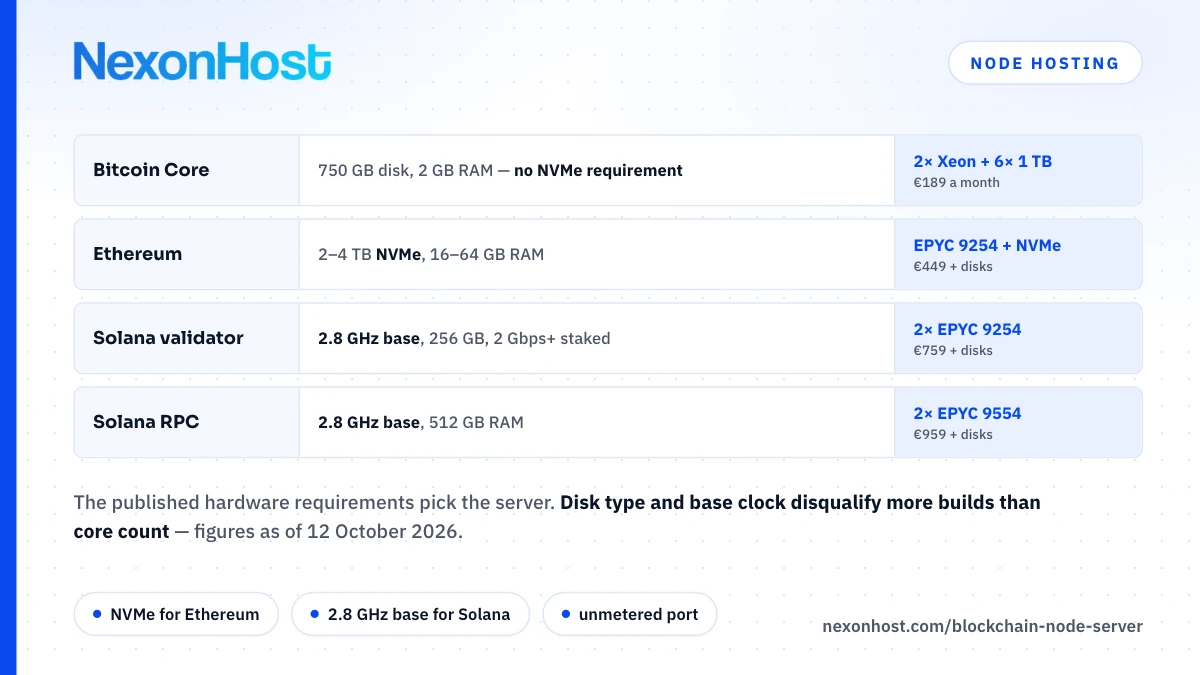
| Node | Published headline figures | Build that fits | From / month |
|---|---|---|---|
| Bitcoin Core, full | 750 GB disk, 2 GB RAM | 2× Xeon E5-2630 v4 + 6× 1 TB SSD | €189 |
| Gensyn RL Swarm (paused), CPU | 32 GB RAM | 2× Xeon E5-2630 v4 | €129 |
| Ethereum full node or validator | 2–4 TB NVMe, 16–64 GB RAM | EPYC 9254 + NVMe drives | €449 + disks |
| Solana validator, staked | 2.8 GHz base, 256 GB, 2 Gbps+ | 2× EPYC 9254, 2 Gbps port | €759 + disks |
| Solana RPC node | 2.8 GHz base, 512 GB | 2× EPYC 9554 | €959 + disks |
Figures as of 12 October 2026, prices ex VAT; check the product page.
Bandwidth: the docs give speeds, the bill counts terabytes
Over a 30-day month: Mbps × 2,592,000 s ÷ 8 ÷ 10^6 = TB.
- Ethereum's 25 Mbit/s minimum, saturated: 25 × 2,592,000 ÷ 8 ÷ 10^6 = 8.1 TB a month each way.
- EIP-7870's 50 Mbps full-node download: 16.2 TB.
- Solana's 2 Gbit/s staked floor: 648 TB; the recommended 10 Gbit/s: 3,240 TB.
- Bitcoin in reverse: 200 GB of upload is 200 × 10^9 × 8 ÷ 2,592,000 s, about 0.62 Mbit/s on average.
Few nodes saturate their link, but a resync can move hundreds of gigabytes in days; ethereum.org recommends an unmetered connection, and bitcoin.org asks for one or for high, monitored upload limits. Every dedicated build ships an unmetered port: 1 Gbps on the Xeons, inside the €129, and a guaranteed 1 Gbps on the EPYCs, inside the €449. One gigabit is 20 times EIP-7870's 50 Mbps; only staked Solana validators need more.
Public nodes attract attacks
bitcoin.org lists being an attack target among a node's possible problems, and validators and public RPC endpoints are obvious targets on any chain. Every dedicated build includes 40 Gbps / 4 Mpps of network DDoS mitigation at Layer 4, with paid tiers from 80 Gbps / 6 Mpps (€250 a month) to 1 Tbps / 100 Mpps (€1,500). Gbps vs Mpps explains which number a flood hits first; ask any provider what happens when an attack exceeds your tier. Layer 4 mitigation filters floods, not valid but expensive RPC calls, so keep RPC private:
- ethereum.org says the execution client's JSON-RPC (port 8545) answers only on localhost by default, and warns that exposing it will "let anyone on the internet control your node".
- Anza does not suggest opening RPC ports 8899 and 8900 to the internet on staked mainnet validators, and recommends limiting SSH to your management IP.
- Open only the peer-to-peer ports: 30303 TCP and UDP for Ethereum execution clients by default, plus your consensus client's (Lighthouse: 9000 TCP/UDP, 9001 UDP), and 8000–8030 TCP and UDP for Agave.
The New Server Security Checklist covers the rest of the first hour.
For full nodes and RPC, a second server in another city is the simplest redundancy; Multi-Region Dedicated Servers covers choosing the pair. Validators differ: ethereum.org says the slashings so far came exclusively from setups with signing keys on two machines at once, while going offline brings small inactivity penalties, not slashing. Keep a synced standby, but load the keys on one machine at a time. That page also strongly encourages your own hardware over a VPS or cloud host, where one outage takes many validators offline together.
When a VPS is enough
Rarely, for mainnet. No NexonHost VPS has more than 32 GB of RAM or 1.6 TB of SSD: short of Ethereum's 2 TB of NVMe and Solana's 256 GB. Anza also warns that Agave on cloud virtual machines needs significantly more expertise.
The exception is a pruned Bitcoin node. bitcoin.org says pruning cuts disk use from over 750 GB to around 7 GB, at the cost of features such as -txindex. That fits a NEX1 Linux VPS (1 vCPU, 2 GB RAM, 40 GB SSD, 4 TB of traffic) at €9 a month: the first month's 740 GB sync plus up to 200 GB of upload stays well inside the quota.
Choosing a blockchain node server
Start from the chain, not the price list: Xeon for Bitcoin Core, EPYC with extra NVMe for Ethereum and Solana. A blockchain node server from NexonHost is a whole machine with an unmetered port and 40 Gbps / 4 Mpps of Layer 4 DDoS mitigation included, in twelve cities: eleven in Europe, plus Ashburn. Every build is on the dedicated servers page; unmetered dedicated servers shows how far each port scales. Staked Solana validators wanting 10 Gbit/s take the 2× EPYC 9254 or 9554 from the 10Gbps dedicated server range, archive nodes above 12 TB the NVMe build among the storage servers. Prices as of 12 October 2026, ex VAT; start on a one-month term and check the product page.
Sources
- ethereum.org — Spin up your own Ethereum node: minimum and recommended hardware, client disk sizes, RPC exposure warning, default ports, retrieved 12 October 2026
- EIP-7870 — Hardware and Bandwidth Recommendations for full nodes, attesters and local block builders (storage IOPS, NVMe over SATA), retrieved 12 October 2026
- ethereum.org — Solo staking: slashing risk from signing keys on two machines, inactivity penalties, VPS/cloud caution, retrieved 12 October 2026
- Anza — Agave Validator Requirements: CPU, RAM, NVMe disks, networking, firewall ports, cloud VMs, retrieved 12 October 2026
- bitcoin.org (community-run, not an official Bitcoin site) — Bitcoin Core requirements: disk, RAM, monthly download and upload, retrieved 12 October 2026
- bitcoin.org — Running a full node: minimum requirements, unmetered or monitored connection, attack target, pruning, retrieved 12 October 2026
- Gensyn — RL Swarm (Paused): no official swarms running, retrieved 12 October 2026
- Gensyn — RL Swarm Getting Started: system requirements, CPU mode, retrieved 12 October 2026
- gensyn-ai/rl-swarm — repository README: "experimental" notice, retrieved 12 October 2026
- Lighthouse Book — Advanced networking: default consensus P2P ports, retrieved 12 October 2026
- PassMark — AMD EPYC 9254 CPU benchmark: single-thread rating 2,998, retrieved 12 October 2026
- AMD — EPYC 9254 specifications: 24 cores, 2.9 GHz base, 4th Generation EPYC 9004 Series, retrieved 12 October 2026
- AMD — EPYC 9554 specifications: 64 cores, 3.1 GHz base, retrieved 12 October 2026
- AMD — EPYC 9754 specifications: 128 cores, 2.25 GHz base, retrieved 12 October 2026
- NexonHost store configurator — Xeon and EPYC builds: base prices, port options, default disks (2× 1 TB NVMe RAID 1 on EPYC 9004 builds), extra NVMe packs (10 × 1 TB €220 on EPYC 9254 builds), Xeon disk options, DDoS tiers, VPS plans (largest: 32 GB RAM on Windows, 1.6 TB SSD on Storage VPS STG4), retrieved 12 October 2026
- Computed — TB per month = Mbps × 2,592,000 s ÷ 8 ÷ 10^6 (25 → 8.1; 50 → 16.2; 2,000 → 648; 10,000 → 3,240); 200 GB × 8 ÷ 2,592,000 s ≈ 0.62 Mbit/s; RAID 1 of 2× 1 TB = 1 TB usable; RAID 10 of 6× 1 TB = 3 TB usable; €79 + €50 + €60 = €189; €599 + €160 = €759; €599 + €800 = €1,399; 1,000 ÷ 50 = 20