Plenty of providers will rent you a VMware dedicated server with ESXi already installed. The harder questions come after checkout: which licence makes the host legal for production, and will the processor run the ESXi version you want? Broadcom has changed both answers since it bought VMware. This guide covers ESXi licensing as it stands on 19 October 2026: what you can buy, how cores are counted, what the free hypervisor allows, and which of NexonHost's seven builds run ESXi 8 and ESX 9. Every licensing fact comes from Broadcom's own documentation; where Broadcom publishes nothing, we say so.
The short answer
| You want | Licence | Version | Builds |
|---|---|---|---|
| Production VMs on one or a few hosts | VVF or VCF subscription, per core | ESXi 8.0 U3 | All seven |
| Production on the 9.x line | VVF or VCF, licensed through VCF Operations | ESX 9.0 or 9.1 | EPYC only |
| A lab or test host | Free vSphere Hypervisor 8, non-production | 8.0 U3e | All seven |
| No VMware bill at all | None: Proxmox VE | Proxmox VE 9 | All seven |
What Broadcom sells in 2026
On 11 December 2023 Broadcom announced the end of sale of perpetual VMware licences and of support renewals for them, beginning that day (effective dates varied). Since then the products have been sold only as subscriptions or term licences. The same announcement cut the line-up to two primary offers: VMware Cloud Foundation (VCF), the full private-cloud stack, and VMware vSphere Foundation (VVF), aimed at mid-sized and smaller customers. Both are licensed per physical core. (Its FAQ also listed vSphere Standard and Essentials Plus for smaller deployments.)
If you already own perpetual vSphere 7 or 8 licences, Broadcom wrote that customers "may continue using perpetual licenses with active support contracts", with support as those contracts define it. You cannot renew that support, though. And 9.x has nowhere to type an old key: Broadcom retired manual entry of 25-character keys with version 9.0.
We found no per-core price published on Broadcom's site and will not guess one, so the arithmetic below counts cores, not euros.
Counting cores on an ESXi dedicated server
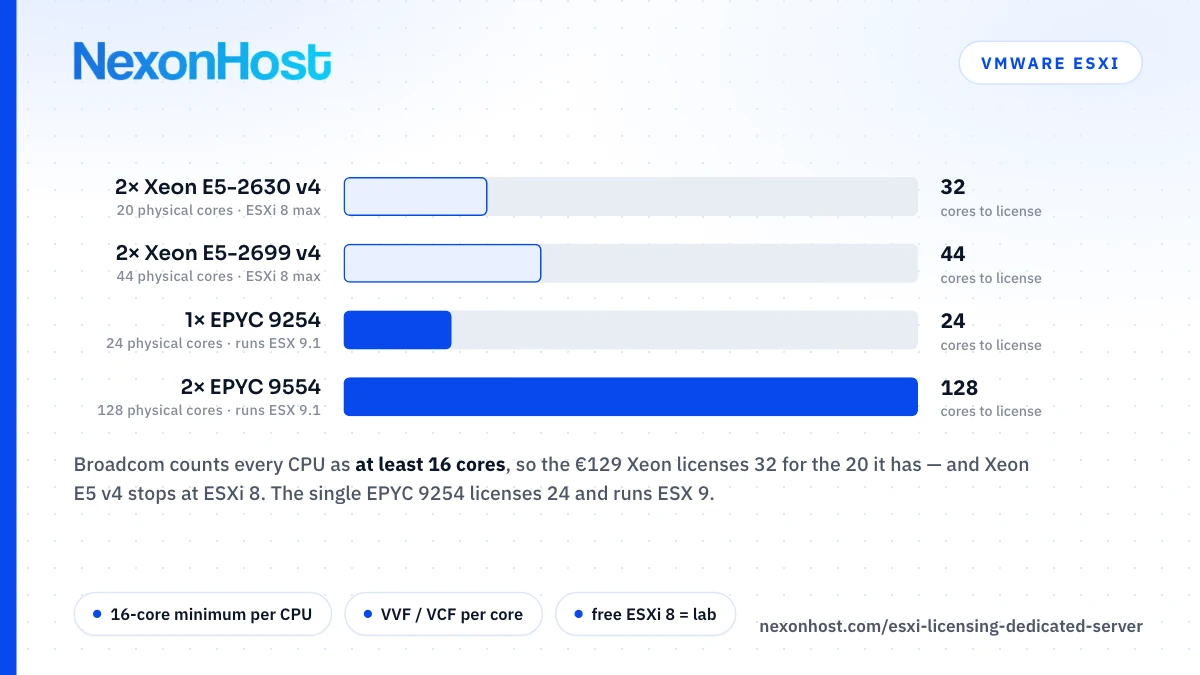
Broadcom's knowledge base article 313548, updated 17 June 2026, sets the rule. Count the physical cores in every ESXi host you intend to license, and count any CPU with fewer than 16 cores as 16. The total runs across every host you license, rented servers included.
| Build | Physical cores | Cores to license | Newest ESXi supported |
|---|---|---|---|
| 2× Xeon E5-2630 v4 | 20 | 32 | 8.0 U3 |
| 2× Xeon E5-2690 v4 | 28 | 32 | 8.0 U3 |
| 2× Xeon E5-2699 v4 | 44 | 44 | 8.0 U3 |
| 1× EPYC 9254 | 24 | 24 | 9.1 |
| 2× EPYC 9254 | 48 | 48 | 9.1 |
| 2× EPYC 9554 | 128 | 128 | 9.1 |
| 2× EPYC 9754 | 256 | 256 | 9.1 |
The entry build has two 10-core Xeons: 2 × 10 = 20 physical cores, but each CPU counts as 16, so 2 × 16 = 32 cores to license, 12 more than the machine has. The E5-2690 v4 build is the same story: 2 × 14 = 28 physical, 32 licensed. From 16 cores per CPU upwards the minimum stops mattering: 2 × 22 = 44 on the E5-2699 v4, and 2 × 64 = 128 on the dual EPYC 9554.
The surprising row is the single EPYC 9254: 24 core licences, a quarter fewer than the €129 Xeon's 32 (24 ÷ 32 = 0.75), on a platform that also runs ESX 9. The cheapest server is not always the cheapest host to license.
The article sets no minimum purchase quantity, only the per-CPU minimum, so ask your partner what minimum order applies.
Which ESXi version each processor runs
The Broadcom Compatibility Guide lists the ESXi releases each CPU series is certified for:
- Intel Xeon E5-2600-v4 Series, which covers all three Xeon builds (Intel files them under the E5 v4 family, formerly Broadwell): ESXi 7.0 through 8.0 Update 3. No 9.x release is listed.
- AMD EPYC 9004 Series, which AMD lists the 9254, 9554 and 9754 under: ESXi 7.0 U3, 8.0 through 8.0 U3, 9.0 and 9.1.
Broadcom's CPU deprecation article 318697, updated 29 September 2026, lists the Xeon E5-2600-V4 (Broadwell-EP) as discontinued for VCF 9.x: the installer halts. The EPYC 9004 series is not on its deprecated list.
In practice, ESXi 8 is the last VMware stop for the Xeon builds. They are good value for a vSphere 8 host today, but plan the next platform before 8.x leaves general support. If you need ESX 9, choose an EPYC build. Xeon vs EPYC compares the two platforms by workload.
The three images at checkout
Every dedicated build offers three VMware images at checkout. Where each stands, from Broadcom's build-number article 316595:
| Image | Released | Status on 19 October 2026 |
|---|---|---|
| ESXi 7.0 U3j | 31 Jan 2023 | 7.x general support ended 2 October 2025 |
| ESXi 8.0b | 14 Feb 2023 | 8.0 line now at Update 3k (29 Jul 2026) |
| ESX 9.0 | 17 Jun 2025 | 9.1 out since 12 May 2026; latest build 12 Oct 2026 |
After 2 October 2025, Broadcom said, vSphere 7 customers would no longer receive product support, security patches or updates. Use 7.0 only to match an existing 7.0 cluster during a migration, and keep it away from internet-facing VMs.
Treat 8.0b and 9.0 as installers, not finished hosts: patch to the current update before you put production VMs on them. Broadcom's build-number article drops the i from 9.0 on (ESX 9.0, ESX 9.1); the compatibility guide still writes ESXi.
The free ESXi, and what free means
In the ESXi 8.0 Update 3e release notes (10 April 2025), Broadcom made the VMware vSphere Hypervisor version 8 available as a free download. Its conditions, from those notes and knowledge base article 399823:
- no Broadcom support;
- cannot be managed by vCenter, and no vMotion, DRS, HA or VADP-based backups;
- at most 8 vCPUs per VM, whatever the host has;
- up to 2 physical CPUs per host, so every build in our range qualifies;
- managing the host through its APIs is not supported; they may return read-only information.
The two documents differ on production use. The release notes say non-production; KB 399823 calls the 8.0 U3e build production-ready under either licence, suggests the free one for home labs and dev/test, and defers to the release notes.
The free licence is embedded in a separate download from Broadcom's support portal. It is not the 8.0b image in our menu, so ask support how to get it onto the server before you order. We found no free edition of ESX 9 in Broadcom's release notes or knowledge base as of 19 October 2026.
Use it for a lab, not for customer workloads.
Licensing ESX 9 on a single rented host
Version 9 changes how a host gets its licence. Broadcom's documentation says subscription license files replace the old keys, that you manage them from a VCF Operations instance and the VCF Business Services console, and that you assign them only to vCenter instances, which then license their hosts. Knowledge base article 404155 adds that licensing a vCenter 9 requires a VCF Operations 9.x appliance attached to it, in a VVF or VCF deployment. Until a licence is assigned, a freshly installed ESX 9 host runs in a 90-day evaluation (article 448638).
On a one-server estate, that means running vCenter and VCF Operations as VMs on the same host or on another machine you run. Their memory and cores come out of what your workloads get. ESXi 8 still takes a key on the host, and VVF and VCF subscriptions include version 8 keys, so for one or two servers, VVF on 8.0 U3 is the simpler path. The 9.x model makes more sense when you already run the management stack for several hosts.
When Proxmox is the better answer
Say it plainly: for many buyers it is.
- You have no Broadcom agreement today. Starting a per-core subscription for one rented host is the expensive way to run VMs.
- You want a Xeon build for years. ESXi 8 is the end of the road on that hardware; Proxmox VE 9 is in the same menu.
- The core count is high. The dual EPYC 9754 needs 256 core licences.
- You want a free hypervisor in production. Broadcom's release notes limit free ESXi to non-production use.
ESXi is the right call when you already pay for VVF or VCF, when the server is a new host or a recovery site for an existing vSphere estate, or when your backup and operations tooling depends on vCenter. Proxmox as a VMware alternative prices the switch per socket and sizes a Proxmox host. The hypervisor comparison covers KVM, Xen and Hyper-V as well.
Where to start
The virtualization servers page lists all seven builds with ESXi 7.0 U3j, 8.0b and 9.0, and Proxmox VE 7 to 9, in the operating system menu. They run from the 2× Xeon E5-2630 v4 at €129 a month, provisioned automatically in minutes, to the 2× EPYC 9754 at €1,519 a month, with about two weeks' delivery. Each includes a 1 Gbps port, one IPv4 address and 40 Gbps / 4 Mpps of Layer 4 DDoS protection. Prices for every build are on dedicated servers.
On ESXi licensing, NexonHost supplies the hardware and the installer image. Before you order, confirm with Broadcom or your partner that your agreement covers hosts on hardware you rent, then tell us whether you bring your own licence and we confirm what applies to your build. To test the fit, start on a one-month term.
Prices as of 19 October 2026, in EUR excluding VAT; check the product page. Broadcom's rules change too, so re-check the articles below before you buy.
Sources
- Counting Cores for VMware Cloud Foundation and vSphere Foundation and TiBs for vSAN — Broadcom KB 313548, updated 17 June 2026: per-core licensing across all ESXi hosts; 16-core minimum per CPU; no minimum order quantity stated. Retrieved 19 October 2026.
- VMware by Broadcom Dramatically Simplifies Offer Lineup and Licensing Model — Broadcom news, 11 December 2023: end of sale of perpetual licences and SnS renewals (effective dates vary); subscriptions or term licences only; VCF and VVF as the two primary offers, vSphere Standard and Essentials Plus in the FAQ; customers may continue using perpetual licences with active support contracts. Retrieved 19 October 2026.
- Broadcom Compatibility Guide — CPU series: Intel Xeon E5-2600-v4 Series supported releases ESXi 7.0 to 8.0 U3; AMD EPYC 9004 Series ESXi 7.0 U3, 8.0 to 8.0 U3, 9.0, 9.1 (listed as ESXi 9.0 and ESXi 9.1). Retrieved 19 October 2026.
- CPU Support Deprecation and Discontinuation In VCF Releases — Broadcom KB 318697, updated 29 September 2026: Xeon E5-2600-V4 (Broadwell-EP) discontinued for VCF 9.x, installation halted; EPYC 9004 not on the deprecated list. Retrieved 19 October 2026.
- Build numbers and versions of VMware ESXi/ESX — Broadcom KB 316595, updated 14 October 2026: release dates of ESXi 7.0 U3j, 8.0b, 8.0 U3e, 8.0 U3k, ESX 9.0, 9.1 and 9.1.1.0100; 9.x release names "ESX 9.0 GA", "ESX 9.1". Retrieved 19 October 2026.
- Reminder: vSphere 7 to reach End of Service on Oct 2, 2025 — VMware Cloud Foundation blog, Broadcom, 31 March 2025: ESXi 7.x end of general support 2 October 2025; no product support, security patches or updates after it. Retrieved 19 October 2026.
- VMware ESXi 8.0 Update 3e release notes — Broadcom TechDocs: released 10 April 2025; free vSphere Hypervisor 8, no Broadcom support, non-production use, no vCenter, 8 vCPUs per VM. Retrieved 19 October 2026.
- VMware ESXi 8.0 Update 3e now available as a Free Hypervisor — Broadcom KB 399823, updated 18 May 2026: up to 2 physical CPUs per host; cannot be managed by vCenter; no vMotion, DRS, HA or VADP backups; host management through APIs not supported; licence embedded in the free download; free licence recommended for home labs and dev/test, 8.0 U3e build called production-ready under either licence; release notes named as the official statement. Retrieved 19 October 2026.
- Licensing vCenter 9.x and ESXi 9.x in Air-gapped Environments — Broadcom KB 404155, updated 14 October 2026: manual entry of 25-character keys retired from 9.0; licensing a vCenter requires a VCF Operations 9.x appliance in a VVF or VCF deployment. Retrieved 19 October 2026.
- VMware Cloud Foundation 9.0 — Licensing Overview, Broadcom TechDocs, updated 29 September 2026: subscription license files replace 25-character keys; licences managed from VCF Operations and the VCF Business Services console; a first subscription also includes version 8.x keys. Retrieved 19 October 2026.
- VMware Cloud Foundation 9.0 — Licensing Model, Broadcom TechDocs, updated 29 September 2026: VCF and vSphere Foundation primary licences are per core; licences are assigned only to vCenter instances, which license their ESX hosts automatically. Retrieved 19 October 2026.
- Your host license expires in -X days — Broadcom KB 448638, updated 19 August 2026: a reinstalled ESX 9.x host starts a fresh 90-day evaluation. Retrieved 19 October 2026.
- AMD EPYC 9254, EPYC 9554 and EPYC 9754 — AMD product pages: EPYC 9004 Series; 24, 64 and 128 cores. Retrieved 19 October 2026.
- Intel Xeon E5-2630 v4, E5-2690 v4 and E5-2699 v4 — Intel specifications: Xeon E5 v4 family, formerly Broadwell; 10, 14 and 22 cores. Retrieved 19 October 2026.
- NexonHost store configurator: builds, cores, prices, delivery, operating system menu (ESXi 7.0 U3j, 8.0b, 9.0; Proxmox VE 7, 8, 9), included port, IPv4 and DDoS tier. Retrieved 19 October 2026.
- Computed: cores to license = CPUs × max(16, cores per CPU); 2 × 16 = 32 against 2 × 10 = 20; 24 ÷ 32 = 0.75.